English
 Español
 tiếng việt
 русский
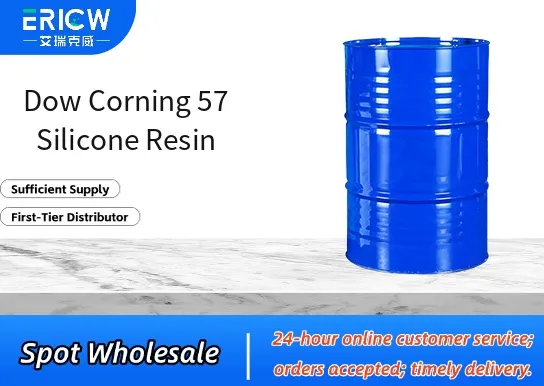
High thermal stability for continuous service up to 200 °C.
Excellent electrical insulation properties even under humid conditions.
Good adhesion to metals, glass, and cured silicone elastomers.
Solvent-based formulation enabling easy dilution and spray or dip application.
Cures at room temperature to form a hard, abrasion-resistant, transparent film.
Electrical insulation coating for transformers, coils, and motor windings.
Protective topcoat for high-temperature gaskets and sealing components.
Surface treatment for enhancing dielectric strength of composite insulators.
Binders in high-temperature resistant ceramic and refractory coatings.
Moisture barrier layer for precision electronic assemblies exposed to harsh environments.
| Chemical Type | Methyl-phenyl silicone resin |
| Product Form | Solution in toluene and xylene |
| Appearance | Clear, colorless to pale yellow liquid |
| Non-Volatile Content | 50–55 wt% (as received) |
| Viscosity (25 °C) | 150–250 cP |
| Density (25 °C) | 0.89–0.91 g/cm³ |
| Flash Point (Tag Closed Cup) | 32–38 °C |
| Primary Applications | High-temperature electrical insulation and protective coatings |
Q1: What is the primary function of Dow Corning 57 Silicone Resin in coating and ink formulations?
A: Dow Corning 57 is a methyl-phenyl silicone resin designed to enhance surface properties—particularly slip, mar resistance, and substrate wetting—without significantly affecting gloss or film integrity. It functions as a surface modifier that migrates to the air–film interface during cure or drying.
Q2: Is Dow Corning 57 compatible with common organic solvent-based systems?
A: Yes, it exhibits good compatibility with a broad range of aromatic and aliphatic hydrocarbons, ketones, and esters. However, limited solubility is observed in highly polar solvents such as alcohols or water, and compatibility should be verified empirically in each specific formulation.
Q3: How does thermal stability influence the processing of Dow Corning 57 in high-bake coatings?
A: Dow Corning 57 retains its structural integrity and functionality up to typical industrial cure temperatures (e.g., 120–180 °C), making it suitable for baked enamel and coil coating applications. Prolonged exposure above 200 °C may lead to gradual oxidative degradation and reduced performance.
Q4: Can Dow Corning 57 be used in UV-curable systems?
A: It can be incorporated into many UV-curable formulations, but its compatibility and final film performance depend on monomer/oligomer chemistry and photoinitiator selection. Testing is recommended to assess potential interference with cure kinetics or surface defect formation.
Q5: What is the typical dosage range for achieving optimal surface effects?
A: It is typically used at low concentrations—generally ranging from 0.1% to 2% by weight relative to total solids—depending on the desired effect intensity, base resin polarity, and application method. Optimization requires formulation-specific evaluation.
Contact With Us:
E-mail: wangxingqiang@ericwchem.com
Have a Questions? Call Us:
Add:
Building A1, Jiete Industrial Park, Huangpu District, Guangzhou City, Guangdong Province, China