English
 Español
 tiếng việt
 русский
Excellent melt processability for high-speed extrusion and injection molding.
Superior soft-touch feel with balanced elasticity and surface tack control.
Good compatibility with polypropylene (PP) and polyethylene (PE) for co-extrusion and overmolding.
Enhanced weather resistance and UV stability for outdoor applications.
Halogen-free formulation meeting RoHS and REACH compliance requirements.
Automotive interior trim components including door panels, armrests, and console covers.
Consumer electronics housings and protective grips for power tools and appliances.
Flexible packaging films requiring seal integrity and puncture resistance.
Medical device grips and ergonomic handles where skin-safe, non-slip surfaces are critical.
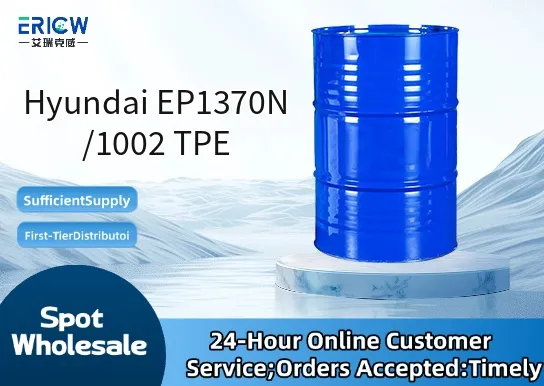
| Chemical Type | Thermoplastic Elastomer (TPE), SEBS-based |
| Product Form | Pellets |
| Appearance | Off-white to light beige granules |
| Shore A Hardness | 70 ± 3 |
| Melt Flow Rate (230°C / 2.16 kg) | 18–22 g/10 min |
| Density (23°C) | 0.905–0.915 g/cm³ |
| Continuous Use Temperature Range | −40°C to +70°C |
| Key Features | Soft-touch, PP-compatible, halogen-free, good UV resistance |
Q1: What is the primary function of Hyundai EP1370N/1002 TPE in polymer formulations?
A: Hyundai EP1370N/1002 TPE is a thermoplastic elastomer modifier designed to enhance flexibility, impact resistance, and melt-processability in rigid thermoplastic matrices—particularly polypropylene (PP) and polyethylene (PE) compounds. It functions as a compatibilized elastomeric phase that improves toughness without significantly compromising stiffness or thermal stability.
Q2: Is EP1370N/1002 suitable for applications requiring regulatory compliance for food contact or medical use?
A: EP1370N/1002 is formulated without intentionally added heavy metals, phthalates, or halogenated flame retardants. While it is commonly used in non-food-contact industrial and automotive components, end-use compliance depends on the full formulation, processing conditions, and final application requirements. Customers must conduct their own regulatory assessment and validation for specific food-contact or medical device applications.
Q3: How should EP1370N/1002 be processed during compounding or injection molding?
A: EP1370N/1002 is supplied in pellet form and is compatible with standard thermoplastic processing equipment. It typically requires drying prior to processing if exposed to high humidity, and melt temperatures should be maintained within the recommended range for TPEs—generally between 160°C and 210°C—depending on base resin and equipment configuration. Residence time should be minimized to preserve elastomeric integrity.
Q4: Can EP1370N/1002 be blended with other elastomers or functional additives?
A: Yes—EP1370N/1002 demonstrates good compatibility with common polyolefin-based elastomers (e.g., EPDM, POE) and standard stabilizers, UV absorbers, and pigments. However, compatibility with polar polymers (e.g., PET, PA) or highly reactive additives should be verified through small-scale trials due to potential interfacial limitations.
Contact With Us:
E-mail: wangxingqiang@ericwchem.com
Have a Questions? Call Us:
Add:
Building A1, Jiete Industrial Park, Huangpu District, Guangzhou City, Guangdong Province, China