English
 Español
 tiếng việt
 русский
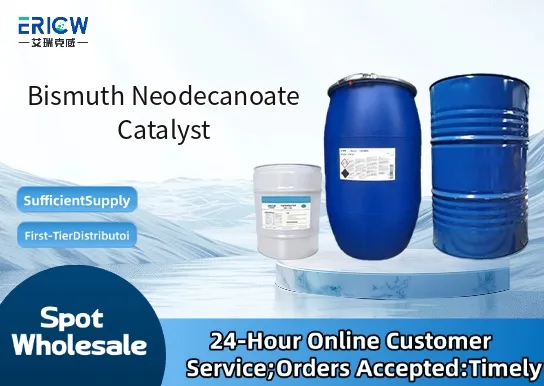
Non-toxic bismuth-based alternative to traditional heavy-metal catalysts (e.g., lead, mercury, tin).
Excellent catalytic activity for polyurethane and polyester resin synthesis at moderate temperatures.
Good thermal stability and low volatility, supporting consistent performance in high-solids and solvent-free formulations.
Hydrolytically stable with minimal sensitivity to ambient moisture during handling and storage.
Readily dispersible in common organic solvents and reactive polymer precursors without gelling or precipitation.
Flexible and rigid polyurethane foam production (slabstock, molded, and integral skin foams).
Catalysis in moisture-cure and one-component polyurethane sealants and adhesives.
Polyester resin crosslinking for coatings, gel coats, and composite matrices.
Alkyd resin modification and ambient-cure coating systems.
Bio-based polyol formulations requiring low-toxicity, REACH-compliant catalysis.
| Chemical Type | Bismuth(III) salt of neodecanoic acid |
| Product Form | Clear to pale yellow liquid |
| Appearance | Homogeneous, free-flowing liquid; no sediment or haze |
| Specific Gravity (25°C) | 1.08–1.12 g/cm³ |
| Viscosity (25°C) | 80–150 mPa·s |
| Bismuth Content (wt%) | 16.0–17.5% |
| Primary Applications | Polyurethane foam, sealants, coatings, polyester resins |
| Regulatory Compliance | REACH registered; RoHS compliant; non-REACH SVHC candidate |
| Common Compatible Systems | Suitability |
| Polyether polyols (e.g., POP, conventional glycols) | Highly Recommended – Excellent compatibility and balanced reactivity profile |
| Aromatic isocyanates (MDI, TDI) | Highly Recommended – Effective gelling and blowing catalysis without side reactions |
| Aliphatic isocyanates (HDI, IPDI) | Recommended – Moderate activity; best used with co-catalysts for full cure |
| Unsaturated polyester resins (UPR) | Suitable – Effective peroxide accelerator at 0.05–0.2% w/w loading |
Q1: What is the CAS Number for Bismuth Neodecanoate Catalyst?
A: The CAS Registry Number is 301-51-9 (generic bismuth carboxylate designation); exact CAS for neodecanoate variant is not assigned—product is identified by specification and batch testing per ISO 9001.
Q2: What is the typical dosage range in polyurethane foam formulations?
A: Standard loading is 0.05–0.3 phr (parts per hundred polyol), depending on desired cream/gel times and foam density; optimization via small-scale trials is recommended.
Q3: How does it compare to dibutyltin dilaurate (DBTDL) in terms of reactivity and safety?
A: Bismuth neodecanoate provides ~70–80% of DBTDL’s gelling activity but delivers superior hydrolytic stability and eliminates reproductive toxicity concerns associated with organotin compounds.
Q4: Is it compliant with food-contact regulations (e.g., FDA 21 CFR, EU 10/2011)?
A: Not approved for direct food-contact applications; intended for industrial intermediates and non-migrating end-products where final formulation undergoes full crosslinking and extraction validation.
Q5: Does bismuth migrate or leach from cured polymers under humid or aqueous conditions?
A: Migration is negligible in fully cured, crosslinked systems; bismuth remains tightly bound within the polymer network and shows no detectable leaching in standard EN 13130 or ASTM D1309 extraction tests.
Contact With Us:
E-mail: wangxingqiang@ericwchem.com
Have a Questions? Call Us:
Add:
Building A1, Jiete Industrial Park, Huangpu District, Guangzhou City, Guangdong Province, China