English
 Español
 tiếng việt
 русский
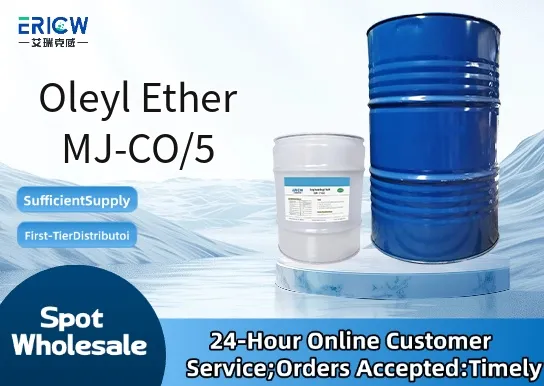
Non-ionic surfactant with excellent emulsifying and solubilizing capacity in oil-in-water systems.
High hydrophile-lipophile balance (HLB ~12.5) enabling broad compatibility across polar and semi-polar formulations.
Derived from renewable oleyl alcohol, supporting sustainable formulation goals without compromising performance.
Low volatility and high thermal stability up to 180 °C, suitable for elevated-temperature processing.
Readily biodegradable under OECD 301 standard conditions, aligning with modern environmental stewardship requirements.
Emulsifier in industrial metalworking fluid concentrates for improved lubricity and phase stability.
Stabilizer in agricultural adjuvant systems to enhance active ingredient dispersion and foliar retention.
Co-surfactant in high-performance cleaning formulations for precision optics and electronics manufacturing.
Wetting agent in water-based coatings and inkjet inks to reduce surface tension and improve substrate penetration.
Carrier and solubilizer for fragrance oils and actives in personal care rinse-off products.
| Chemical Type | Oleyl alcohol ethoxylate (average EO = 5) |
| Product Form | Clear, viscous liquid |
| Appearance | Pale yellow to colorless, homogeneous liquid |
| Melting Point | –12 °C to –8 °C |
| pH (1% aqueous solution, 25 °C) | 5.5 – 7.0 |
| Cloud Point (1% aqueous solution) | ~82 °C |
| Primary Applications | Emulsification, solubilization, wetting, stabilization |
| Regulatory Compliance | REACH registered; compliant with EU Cosmetics Regulation (EC) No 1223/2009; non-GMO |
| Common Compatible Systems | Suitability |
| Mineral oil–based metalworking fluids | Highly Recommended – Provides stable microemulsions with low haze and extended shelf life. |
| Aqueous pesticide suspension concentrates (SC) | Recommended – Enhances particle dispersion and reduces sedimentation; may require co-formulants for long-term storage. |
| Waterborne acrylic and polyurethane dispersions | Suitable – Effective wetting agent at 0.2–0.8 wt%; minimal impact on film formation or gloss. |
| Glycerin–propylene glycol solvent systems | Highly Recommended – Fully miscible; improves solubilization of hydrophobic actives without phase separation. |
Q1: What is the CAS Registry Number for Oleyl Ether MJ-CO/5?
A: The CAS number is 68439-49-6 (generic for oleyl alcohol ethoxylates with average EO=5); batch-specific COA includes verified identity confirmation via ¹H-NMR and GC-MS.
Q2: What is the recommended usage level in emulsion formulations?
A: Typical dosage ranges from 1.5–5.0 wt% relative to total formulation, depending on oil phase polarity and desired droplet size; start at 2.5% and optimize via stability testing (centrifuge, thermal cycling, freeze-thaw).
Q3: How does Oleyl Ether MJ-CO/5 compare to linear alcohol ethoxylates (e.g., C12–C15 AE-7) in hard-surface cleaning?
A: It offers superior grease-cutting efficiency and lower foaming in high-shear applications due to its unsaturated oleyl chain enhancing interfacial mobility; however, it exhibits slightly reduced calcium tolerance above 150 ppm hardness.
Q4: Is Oleyl Ether MJ-CO/5 compliant with FDA 21 CFR for indirect food contact applications?
A: Yes — approved under 21 CFR §173.370 as a defoamer/emulsifier in food processing equipment lubricants (H1 category) when used within specified limits and sourced from FDA-listed facilities.
Q5: Does it exhibit migration or extraction risk in polymer packaging films?
A: Migration potential is low (<0.05 mg/dm² in PET/PE laminates per EC 10/2011 testing at 40 °C/10 days); no detectable extraction into aqueous or 10% ethanol simulants under standard EN 13130 protocols.
Contact With Us:
E-mail: wangxingqiang@ericwchem.com
Have a Questions? Call Us:
Add:
Building A1, Jiete Industrial Park, Huangpu District, Guangzhou City, Guangdong Province, China