English
 Español
 tiếng việt
 русский
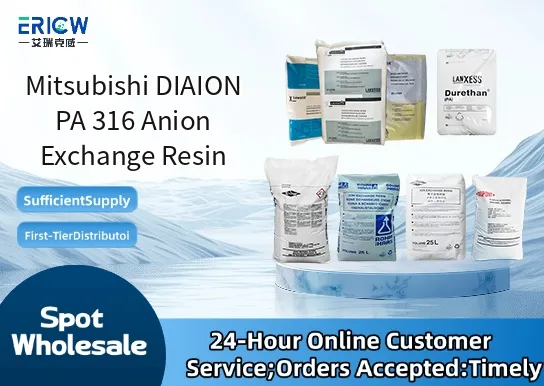
Highly selective for nitrate (NO₃⁻) and perchlorate (ClO₄⁻) removal from drinking water and process streams.
Strong-base, Type I quaternary ammonium functional group provides excellent chemical stability in oxidizing environments.
Optimized bead uniformity and mechanical strength for low pressure drop and extended service life in fixed-bed systems.
Low soluble organic compound (SOC) leaching, meeting stringent regulatory requirements for potable water applications.
Regenerable with standard sodium chloride (NaCl) brine, enabling cost-effective cyclic operation.
Drinking water treatment for selective removal of nitrate and perchlorate contaminants.
Groundwater remediation in municipal and industrial settings affected by agricultural runoff or aerospace industry discharges.
Pretreatment for ultrapure water systems requiring low anionic impurity levels prior to polishing stages.
Wastewater polishing in semiconductor and pharmaceutical manufacturing facilities.
Recycling rinse water in metal finishing operations where chloride and sulfate control is critical.
| Chemical Type | Strong-base anion exchange resin, Type I quaternary ammonium |
| Product Form | Moist, spherical beads |
| Appearance | Off-white to light yellow, uniform spherical beads |
| Functional Group | –N⁺(CH₃)₃ (trimethylammonium) |
| Moisture Content | Approx. 48–52% (as shipped) |
| Ion Form | Chloride (Cl⁻) form as standard |
| Particle Size Range | 0.4 – 1.2 mm (95% retained on 0.315 mm sieve) |
| Uniformity Coefficient | ≤ 1.6 |
Q1: What is the primary functional group and matrix structure of DIAION PA 316?
A: DIAION PA 316 is a macroporous, strongly basic anion exchange resin with quaternary ammonium functional groups (Type I) grafted onto a styrene-divinylbenzene copolymer matrix. Its macroporous structure provides enhanced kinetic performance and resistance to fouling in challenging feed streams.
Q2: In which types of water treatment applications is PA 316 most commonly used?
A: PA 316 is widely employed in high-purity water production—especially for nitrate, sulfate, and silica removal in power plant boiler feedwater, pharmaceutical process water, and electronics-grade ultrapure water systems. It is also selected for selective anion removal in industrial wastewater polishing where organic fouling potential exists.
Q3: How does PA 316 compare to gel-type anion resins in terms of chemical stability and regeneration efficiency?
A: Due to its macroporous architecture and robust crosslinked matrix, PA 316 offers superior resistance to oxidation and osmotic shock compared to conventional gel-type resins. It maintains consistent capacity and pressure drop over extended service cycles and regenerates efficiently with standard sodium hydroxide solutions—even in the presence of moderate organic or colloidal content.
Q4: Is PA 316 suitable for use in food-contact or pharmaceutical water systems?
A: Yes—PA 316 is manufactured and tested in compliance with global regulatory expectations for ion exchange resins used in water purification for pharmaceutical and food-grade applications. It meets relevant pharmacopoeial requirements for extractables and structural integrity when operated within validated process parameters and proper pretreatment protocols.
Contact With Us:
E-mail: wangxingqiang@ericwchem.com
Have a Questions? Call Us:
Add:
Building A1, Jiete Industrial Park, Huangpu District, Guangzhou City, Guangdong Province, China