English
 Español
 tiếng việt
 русский
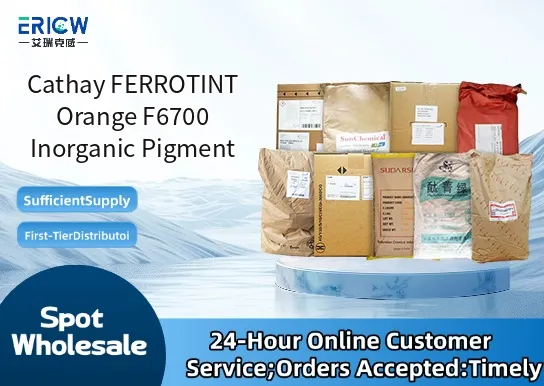
High thermal stability suitable for processing temperatures up to 800 °C.
Excellent lightfastness and weather resistance in outdoor applications.
Non-toxic, heavy-metal-free formulation compliant with global environmental regulations.
Superior dispersion performance in aqueous and solvent-based systems.
Consistent hue and high chroma across production batches.
Ceramic glazes and underglaze colorants.
Architectural concrete and precast concrete products.
High-performance industrial coatings for infrastructure and machinery.
Plastic coloration for automotive interior components.
Fire-resistant building materials and refractory mortars.
| Chemical Type | Iron-based mixed metal oxide (Fe-Zn-Cr) |
| Product Form | Free-flowing fine powder |
| Appearance | Uniform bright orange-red powder |
| Primary Applications | Ceramics, concrete, coatings, plastics, refractories |
| Key Features | Heat stable, UV resistant, chemically inert, non-volatile |
| Benefits | Color consistency, low abrasivity, minimal impact on matrix properties |
| Particle Size (D50) | 0.8–1.2 µm |
| pH (10% aqueous slurry) | 6.5–7.5 |
Q1: What is the primary chemical composition of Cathay FERROTINT Orange F6700?
A: Cathay FERROTINT Orange F6700 is a high-performance inorganic pigment based on complex iron oxide–zinc oxide mixed-phase chemistry, engineered for enhanced thermal stability and lightfastness. It does not contain heavy metals such as lead, cadmium, or chromium(VI).
Q2: Is this pigment suitable for use in food-contact plastics?
A: Yes, Cathay FERROTINT Orange F6700 is formulated to meet general requirements for pigments used in food-contact polymer applications, provided it is incorporated within approved polymer matrices and processing conditions. Final compliance depends on full system evaluation per applicable regional regulations.
Q3: How does F6700 perform under high-temperature processing, such as injection molding or extrusion?
A: This pigment demonstrates excellent thermal stability, retaining its orange hue and dispersion integrity at typical polymer processing temperatures up to 280 °C. It is especially suited for polyolefins, engineering thermoplastics, and masterbatch applications requiring robust heat resistance.
Q4: Can F6700 be used in aqueous systems like architectural coatings or water-based inks?
A: While primarily optimized for polymer coloration, F6700 can be adapted for aqueous dispersions with appropriate surface treatment and stabilization. Performance in water-based systems may require formulation support to ensure optimal rheology, gloss retention, and sedimentation resistance.
Contact With Us:
E-mail: wangxingqiang@ericwchem.com
Have a Questions? Call Us:
Add:
Building A1, Jiete Industrial Park, Huangpu District, Guangzhou City, Guangdong Province, China