English
 Español
 tiếng việt
 русский
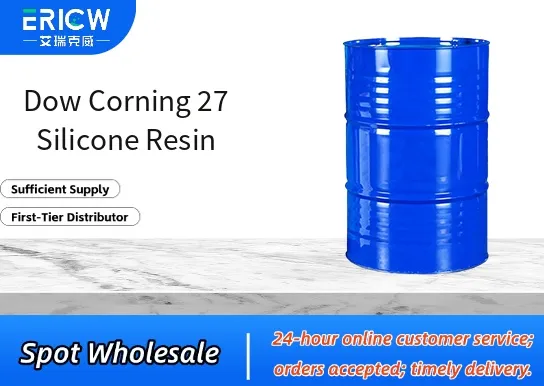
High thermal stability with continuous service capability up to 200 °C.
Excellent electrical insulation properties across wide temperature and frequency ranges.
Good compatibility with organic resins and pigments for hybrid formulation systems.
Low surface energy enabling effective release and anti-stick performance in coatings.
Solvent-based liquid format for straightforward integration into conventional coating and impregnation processes.
Electrical insulation varnishes for motors, transformers, and coil windings.
Heat-resistant topcoats for industrial appliances and oven interiors.
Release coatings for silicone paper, film, and composite laminates.
Binders in high-temperature pigment systems for ceramic and metal substrates.
Component in hybrid organic-inorganic protective coatings for aerospace components.
| Chemical Type | Methyl-phenyl silicone resin |
| Product Form | Liquid (toluene/xylene solution) |
| Appearance | Clear, colorless to pale yellow liquid |
| Solids Content | 50 ± 2 wt% |
| Viscosity (25 °C, Brookfield RV) | 1,500–3,000 cP |
| Density (25 °C) | 0.92–0.96 g/cm³ |
| Flash Point (Tag Closed Cup) | Approx. 40 °C |
| Primary Applications | Electrical insulation, heat-resistant coatings, release systems |
Q1: What is the primary function of Dow Corning® 27 Silicone Resin in coating and ink formulations?
A: Dow Corning® 27 Silicone Resin functions primarily as a surface modifier and release agent, enhancing slip, abrasion resistance, and substrate release properties without significantly affecting gloss or adhesion of the base system.
Q2: Is Dow Corning® 27 compatible with common organic resin systems such as acrylics, polyurethanes, and alkyds?
A: Yes, Dow Corning® 27 exhibits good compatibility with a broad range of thermosetting and thermoplastic resins, including acrylics, polyurethanes, and alkyds, particularly when properly dispersed via high-shear mixing or solvent dilution prior to incorporation.
Q3: How should Dow Corning® 27 be incorporated into a formulation to ensure optimal performance?
A: It is recommended to pre-dilute Dow Corning® 27 in a compatible solvent (e.g., xylene, toluene, or isopropanol) and add it during the let-down stage under moderate to high shear. Avoid high-temperature addition before solvent removal to prevent premature phase separation.
Q4: Can Dow Corning® 27 be used in heat-cured systems?
A: Yes, Dow Corning® 27 is thermally stable and retains functionality in baking applications up to typical cure temperatures for industrial coatings (e.g., 120–180 °C), though extended exposure above 200 °C may affect its surface-active behavior.
Q5: Does Dow Corning® 27 require post-application curing or activation to develop its full effect?
A: No—its surface migration and orientation occur spontaneously during film formation and ambient drying or low-temperature baking; no additional activation step is needed for initial performance development.
Contact With Us:
E-mail: wangxingqiang@ericwchem.com
Have a Questions? Call Us:
Add:
Building A1, Jiete Industrial Park, Huangpu District, Guangzhou City, Guangdong Province, China