English
 Español
 tiếng việt
 русский
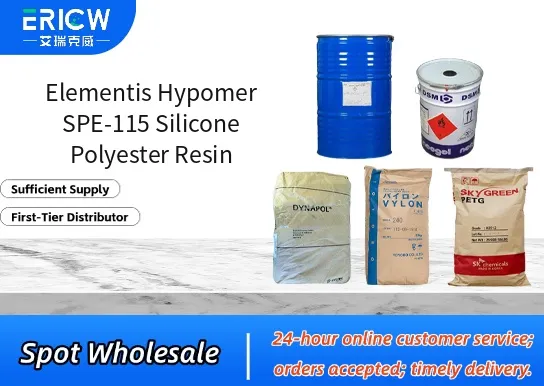
Hybrid silicone-polyester architecture delivering enhanced thermal stability and UV resistance.
Low-viscosity liquid resin enabling excellent flow, leveling, and substrate wetting.
Compatible with conventional polyester, acrylic, and melamine crosslinkers for flexible formulation design.
Reduces surface tension to minimize defects such as cratering and orange peel in high-performance coatings.
Non-yellowing performance under prolonged heat exposure, supporting durable architectural and industrial finishes.
High-gloss coil coatings for pre-painted metal (PPM) used in building panels and appliances.
Exterior architectural coatings requiring long-term color retention and chalk resistance.
Industrial maintenance coatings for metal substrates exposed to elevated temperatures or weathering.
Powder coating modifiers to improve transfer efficiency and film uniformity.
| Chemical Type | Silicone-modified polyester resin |
| Product Form | Clear to pale yellow liquid |
| Appearance | Homogeneous, low-viscosity liquid |
| Primary Applications | Coil coatings, architectural coatings, industrial maintenance coatings |
| Key Features | Thermal stability, UV resistance, low surface tension, non-yellowing |
| Benefits | Improved film integrity, reduced coating defects, extended service life under harsh conditions |
| Solvent Compatibility | Compatible with aromatic and aliphatic hydrocarbons, esters, and ketones |
| Storage Stability | Stable for ≥12 months at 15–25°C in sealed containers |
Q1: What is the primary function of Hypomer SPE-115 in coating formulations?
A: Hypomer SPE-115 functions as a silicone-modified polyester resin that enhances surface migration, improves substrate wetting, and imparts controlled slip and mar resistance—particularly in high-performance industrial and decorative coatings.
Q2: Is Hypomer SPE-115 compatible with common thermoset resin systems?
A: Yes, it demonstrates good compatibility with melamine-formaldehyde, urea-formaldehyde, and isocyanate crosslinkers, as well as with acrylic, polyester, and alkyd base resins—making it suitable for baked and ambient-cure coating systems.
Q3: How should Hypomer SPE-115 be incorporated into a formulation?
A: It is typically added during the let-down stage under moderate agitation. Pre-dilution in a compatible solvent or carrier resin may aid dispersion, especially in low-solids or high-viscosity systems.
Q4: Does Hypomer SPE-115 affect film hardness or cure response?
A: At recommended use levels, it generally does not significantly retard cure kinetics or compromise through-hardness. However, excessive addition may influence crosslink density and surface properties—formulation optimization is advised.
Q5: Can Hypomer SPE-115 be used in waterborne systems?
A: While primarily designed for solvent-borne applications, it can be incorporated into certain waterborne hybrid systems—typically via pre-emulsification or co-solvent-assisted dispersion—but performance and stability must be validated case by case.
Contact With Us:
E-mail: wangxingqiang@ericwchem.com
Have a Questions? Call Us:
Add:
Building A1, Jiete Industrial Park, Huangpu District, Guangzhou City, Guangdong Province, China