English
 Español
 tiếng việt
 русский
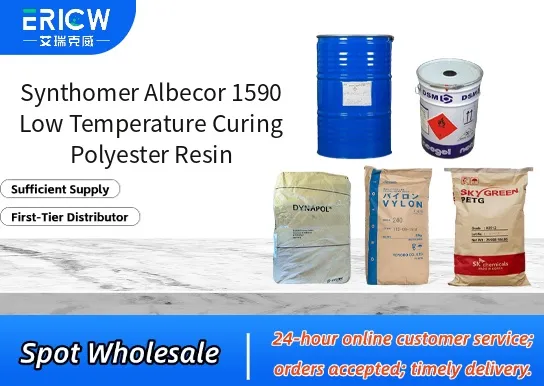
Enables efficient curing at ambient to moderately elevated temperatures (as low as 15–25°C with appropriate catalysts), reducing energy consumption.
Delivers excellent adhesion to diverse substrates including metals, composites, and primed plastics.
Offers good chemical resistance to dilute acids, alkalis, and common solvents after full cure.
Provides balanced flexibility and hardness, minimizing microcracking under thermal or mechanical stress.
Compatible with standard free-radical initiators (e.g., MEKP) and exhibits consistent pot life control at room temperature.
Industrial coatings for metal furniture and enclosures requiring low-energy curing.
Repair and protective topcoats for marine and offshore composite structures.
Decorative laminates and sheet moulding compounds (SMC) for automotive interior components.
Low-bake gel coats for wind turbine blade repair and refurbishment.
Adhesive primers and tie-coats in multi-layer composite bonding systems.
| Chemical Type | Unsaturated polyester resin |
| Product Form | Liquid, solvent-free |
| Appearance | Clear to pale yellow viscous liquid |
| Primary Applications | Coatings, gel coats, laminating resins, SMC/BMC formulations |
| Key Features | Low-temperature curability, high reactivity, good weather resistance |
| Benefits | Reduced energy costs, improved production throughput, enhanced substrate compatibility |
| Recommended Catalyst | Methyl ethyl ketone peroxide (MEKP) – 0.8–1.5 wt% typical |
| Storage Stability | 6 months at ≤25°C in sealed containers, protected from light and moisture |
Q1: What is the primary advantage of using Albecor 1590 in low-temperature curing applications?
A: Albecor 1590 is specifically formulated to enable efficient crosslinking at reduced temperatures—typically between 80 °C and 120 °C—making it suitable for heat-sensitive substrates such as certain plastics, coated metals, or pre-assembled components where conventional high-temperature curing is impractical or damaging.
Q2: Is Albecor 1590 compatible with common polyester resin systems and additives?
A: Yes, Albecor 1590 is designed to integrate smoothly into standard unsaturated polyester resin formulations. It demonstrates good compatibility with common accelerators, inhibitors, fillers, and pigments used in industrial coating and composite applications, though compatibility testing under end-use conditions is recommended.
Q3: How does Albecor 1590 contribute to film formation and final coating performance?
A: As a reactive co-resin, Albecor 1590 enhances crosslink density at lower cure temperatures, supporting improved hardness, chemical resistance, and adhesion without compromising flexibility. Final film properties are formulation-dependent but generally show robust performance in decorative and protective coatings.
Q4: Can Albecor 1590 be used in solvent-free or high-solids systems?
A: Yes—Albecor 1590 is supplied as a low-viscosity liquid and is well-suited for both solvent-free and high-solids polyester-based systems. Its reactivity profile supports efficient processing in roll-coating, spray, and dip applications without requiring excessive dilution.
Contact With Us:
E-mail: wangxingqiang@ericwchem.com
Have a Questions? Call Us:
Add:
Building A1, Jiete Industrial Park, Huangpu District, Guangzhou City, Guangdong Province, China