English
 Español
 tiếng việt
 русский
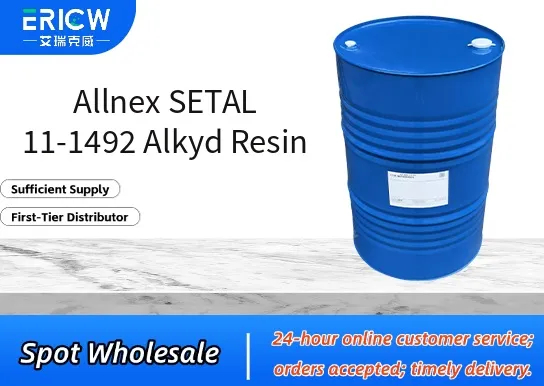
Medium-oil-length alkyd resin based on phthalic anhydride and soybean oil fatty acids.
Designed for excellent gloss retention and through-dry performance in air-drying coatings.
Offers balanced hardness development and flexibility for durable film formation.
Compatible with common solvents, nitrocellulose, vinyl resins, and melamine-formaldehyde crosslinkers.
Provides good pigment wetting and substrate adhesion on wood, metal, and primed surfaces.
General-purpose air-drying industrial maintenance coatings.
Wood finishing systems including furniture, cabinets, and interior trim.
Metal protective coatings for agricultural and construction equipment.
Refinish coatings for automotive and motorcycle components.
Low-VOC decorative architectural enamels and varnishes.
| Chemical Type | Phthalic–soybean oil alkyd resin |
| Product Form | Liquid, solvent-borne (xylene/toluene blend) |
| Appearance | Clear to slightly hazy amber liquid |
| Non-Volatile Content (wt%) | ~50–52% |
| Acid Value (mg KOH/g) | 6–10 |
| Saponification Value (mg KOH/g) | 170–190 |
| Iodine Value (g I₂/100 g) | 130–150 |
| Viscosity (25°C, mPa·s) | 800–1,200 |
Q1: What is the primary application area for SETAL 11-1492?
A: SETAL 11-1492 is a medium-oil-length alkyd resin designed primarily for solvent-based decorative and protective coatings, including interior/exterior architectural paints, wood finishes, and general industrial maintenance coatings where balanced drying performance, gloss retention, and substrate adhesion are required.
Q2: Is SETAL 11-1492 compatible with common co-resins and modifiers?
A: Yes — it exhibits good compatibility with melamine-formaldehyde resins, urea-formaldehyde resins, and acrylic co-polymers in baked systems, as well as with rosin esters and ketone resins in ambient-cure formulations. Compatibility testing under actual formulation conditions is recommended to confirm stability and film performance.
Q3: How does SETAL 11-1492 perform in terms of drying and through-dry characteristics?
A: As a cobalt-free, air-drying alkyd, it delivers reliable surface dry and progressive through-dry via oxidative crosslinking. Drying behavior is influenced by film thickness, ambient temperature/humidity, and catalyst selection — typical formulations achieve handling dry in 4–8 hours and full cure within several days under standard conditions.
Q4: Can SETAL 11-1492 be used in low-VOC formulations?
A: Yes — its medium oil length and optimized fatty acid profile support formulation at reduced solvent levels. It is commonly employed in solvent-borne systems targeting VOC content below 400 g/L, though final compliance depends on the full formulation, including solvents, pigments, and additives.
Contact With Us:
E-mail: wangxingqiang@ericwchem.com
Have a Questions? Call Us:
Add:
Building A1, Jiete Industrial Park, Huangpu District, Guangzhou City, Guangdong Province, China