English
 Español
 tiếng việt
 русский
High-gloss, excellent flow and leveling for premium surface aesthetics.
Outstanding weather resistance and UV stability for long-term outdoor performance.
Good chemical resistance to household cleaners and mild industrial solvents.
Optimized reactivity for efficient curing with TGIC-free or low-TGIC powder formulations.
Consistent batch-to-batch reproducibility supporting reliable manufacturing scale-up.
Architectural aluminum extrusions (e.g., window frames, curtain walls).
Outdoor furniture and garden equipment coatings.
Automotive exterior trim and non-under-hood components.
General industrial metal finishing for durable consumer and commercial goods.
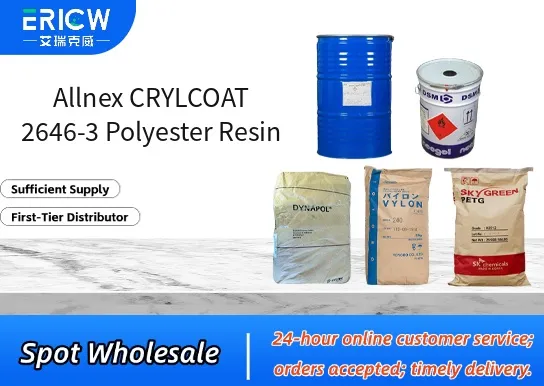
| Chemical Type | Carboxyl-functional saturated polyester |
| Product Form | Free-flowing granular solid |
| Appearance | White to off-white granules |
| Acid Value (mg KOH/g) | 27–33 |
| Gardner Color | ≤ 3 |
| Melt Viscosity (Pa·s, 180 °C) | 3,500–5,500 |
| Softening Point (°C, ASTM E28) | 78–84 |
| Primary Applications | Exterior-grade TGIC-free and low-TGIC thermosetting powder coatings |
Q1: What is the primary application of CRYLCOAT 2646-3 in powder coating formulations?
A: CRYLCOAT 2646-3 is a carboxyl-functional polyester resin specifically designed for use in TGIC-free, high-gloss, and durable thermosetting powder coatings—particularly for indoor architectural and general industrial applications where excellent flow, leveling, and mechanical performance are required.
Q2: Is CRYLCOAT 2646-3 compatible with common crosslinkers used in powder coatings?
A: Yes, it is formulated to react efficiently with standard epoxy-based crosslinkers such as triglycidyl isocyanurate (TGIC) alternatives—including hydroxyalkyl amide (HAA) systems—and exhibits good compatibility with various curing agents to achieve full cure at typical powder coating bake schedules (e.g., 180–200 °C for 10–20 minutes).
Q3: How does CRYLCOAT 2646-3 contribute to film properties like flexibility and chemical resistance?
A: Its molecular architecture delivers a balanced profile: good substrate adhesion and flexibility without sacrificing hardness or resistance to common household chemicals and mild solvents. Final film performance depends on formulation design, including crosslinker type and pigment/binder ratio.
Q4: Can CRYLCOAT 2646-3 be used in low-cure or energy-efficient powder coating systems?
A: While optimized for conventional cure conditions, it can be adapted for reduced-temperature curing when paired with reactive accelerators and carefully adjusted formulation parameters—though full property development may require validation under specific process conditions.
Contact With Us:
E-mail: wangxingqiang@ericwchem.com
Have a Questions? Call Us:
Add:
Building A1, Jiete Industrial Park, Huangpu District, Guangzhou City, Guangdong Province, China