English
 Español
 tiếng việt
 русский
Broad-spectrum antimicrobial activity against bacteria, fungi, and algae.
Stable in water-based formulations across a wide pH range (pH 4–10).
Low volatility and minimal odor, enhancing workplace safety and user acceptance.
Compatible with common surfactants, thickeners, and polymers used in industrial formulations.
Effective at low use concentrations, supporting cost-efficient dosing and reduced environmental impact.
Preservation of water-based metalworking fluids.
Microbial control in industrial cleaning compounds and detergents.
Protection of latex paints and architectural coatings during storage and application.
Stabilization of adhesives, sealants, and caulks against spoilage.
Preservation of pigment dispersions and aqueous polymer emulsions.
| Chemical Type | Blend of isothiazolinone biocides (5-chloro-2-methyl-4-isothiazolin-3-one and 2-methyl-4-isothiazolin-3-one) |
| Product Form | Aqueous solution |
| Appearance | Clear, light yellow to amber liquid |
| pH (1% aqueous solution) | 2.5–4.5 |
| Density (20°C) | 1.08–1.12 g/cm³ |
| Solubility | Completely miscible with water |
| Primary Applications | Industrial preservation for water-based formulations |
| Key Features | Broad-spectrum efficacy, formulation stability, low-dose performance |
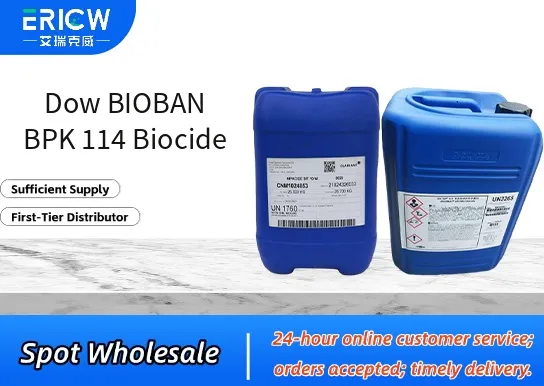
Q1: What is the primary mode of action of Dow BIOBAN BPK 114 Biocide?
A: Dow BIOBAN BPK 114 Biocide functions primarily as a broad-spectrum preservative through disruption of microbial cell membranes and interference with essential cellular processes, providing effective control against bacteria, yeasts, and molds in industrial formulations.
Q2: In which types of industrial products is Dow BIOBAN BPK 114 commonly used?
A: It is widely employed in water-based industrial systems such as metalworking fluids, latex paints and coatings, adhesives, construction chemicals, and cleaning formulations where long-term microbial stability is required under challenging pH and temperature conditions.
Q3: How stable is Dow BIOBAN BPK 114 in alkaline or acidic environments?
A: The biocide demonstrates good hydrolytic stability across a broad pH range, typically maintaining efficacy from approximately pH 4 to pH 10, making it suitable for use in both mildly acidic and moderately alkaline industrial formulations.
Q4: Is Dow BIOBAN BPK 114 compatible with common formulation ingredients like surfactants and thickeners?
A: Yes, it generally exhibits good compatibility with anionic, nonionic, and amphoteric surfactants, as well as common rheology modifiers and emulsifiers—though compatibility should always be verified experimentally within the specific formulation matrix.
Q5: What is the typical dosage range for effective preservation using Dow BIOBAN BPK 114?
A: Effective dosage depends on formulation composition, microbial challenge, and storage conditions, but it is typically used at low concentrations—generally ranging from 0.1% to 2% by weight of the final product—with optimal levels determined through challenge testing.
Contact With Us:
E-mail: wangxingqiang@ericwchem.com
Have a Questions? Call Us:
Add:
Building A1, Jiete Industrial Park, Huangpu District, Guangzhou City, Guangdong Province, China