English
 Español
 tiếng việt
 русский
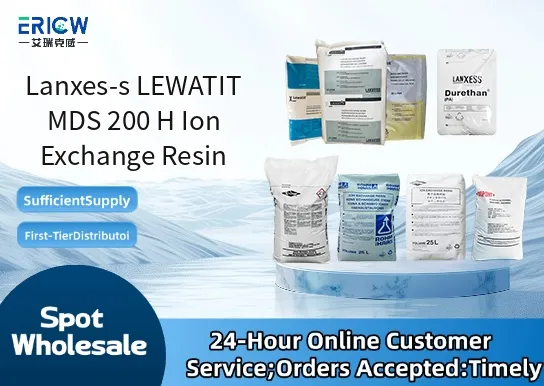
Highly stable macroporous polystyrene-divinylbenzene matrix for superior mechanical and osmotic shock resistance.
Sulfonic acid functional groups providing strong cation exchange capacity and excellent regeneration efficiency.
Optimized particle size distribution (0.4–1.2 mm) ensuring low pressure drop and uniform flow dynamics in industrial columns.
Low soluble organic carbon (SOC) release, meeting stringent requirements for pharmaceutical and ultrapure water applications.
Compatible with high-concentration regenerants including NaCl, HCl, and H₂SO₄ under standard operating conditions.
Dealkalization and softening of boiler feed water in power generation plants.
Pretreatment for reverse osmosis (RO) systems to protect membranes from hardness scaling.
Production of ultrapure water (UPW) for semiconductor manufacturing and microelectronics rinsing.
Cation removal in pharmaceutical-grade water systems compliant with USP <841> and EP 2.2.58.
Recovery and concentration of metal ions in hydrometallurgical process streams.
| Chemical Type | Strongly acidic cation exchanger (sulfonic acid) |
| Product Form | Moist, spherical beads |
| Appearance | Opaque amber to brown beads |
| Functional Group | –SO₃H |
| Matrix Structure | Macroporous polystyrene-divinylbenzene copolymer |
| Ion Form | H⁺ form (ready-to-use) |
| Moisture Content | Approx. 48–52 % (w/w) |
| Uniformity Coefficient | ≤ 1.6 |
Q1: What is the primary functional group and ionic form of LEWATIT MDS 200 H?
A: LEWATIT MDS 200 H is a strongly acidic cation exchange resin based on a styrene-divinylbenzene matrix, functionalized with sulfonic acid groups, and supplied in the hydrogen (H⁺) form.
Q2: Is this resin suitable for deionization or polishing of process water in pharmaceutical or electronics applications?
A: Yes — LEWATIT MDS 200 H is commonly employed in high-purity water treatment systems, including mixed-bed configurations for final polishing, due to its high chemical stability, low extractables, and consistent exchange capacity under controlled regeneration protocols.
Q3: How does temperature affect the performance and operational lifetime of this resin?
A: Performance remains stable across typical industrial operating temperatures (5–50 °C); however, prolonged exposure above 50 °C may accelerate physical degradation and reduce long-term capacity retention. Optimal service life is achieved within recommended thermal and hydraulic loading limits.
Q4: Can LEWATIT MDS 200 H be regenerated, and what are the standard regeneration agents?
A: Yes — it is fully regenerable using dilute mineral acids such as hydrochloric acid (HCl) or sulfuric acid (H₂SO₄). Regeneration efficiency depends on acid concentration, contact time, flow rate, and the nature of accumulated cations.
Contact With Us:
E-mail: wangxingqiang@ericwchem.com
Have a Questions? Call Us:
Add:
Building A1, Jiete Industrial Park, Huangpu District, Guangzhou City, Guangdong Province, China