English
 Español
 tiếng việt
 русский
High thermal conductivity (≈ 35–60 W/m·K at room temperature) enabling efficient heat dissipation in high-power devices.
Excellent lattice match with perovskite oxides (e.g., LSMO, STO), supporting epitaxial growth of high-quality thin films.
Wide bandgap (~7.8 eV) and high electrical resistivity (>10¹⁰ Ω·cm), ensuring superior dielectric performance and optical transparency in UV range.
Chemically inert and stable in oxidizing environments up to 1800 °C, resisting reaction with common sputtering or MBE precursors.
Low intrinsic defect density and atomically flat surface (RMS roughness < 0.2 nm over 5×5 µm), verified by AFM and XRD rocking curve FWHM < 0.02°.
Heteroepitaxial growth of complex oxide thin films for spintronics and multiferroic devices.
Substrate for high-temperature superconducting (HTS) YBCO and LSCO film deposition via pulsed laser deposition (PLD) or sputtering.
Platform for quantum materials research including topological insulators and 2D oxide heterostructures.
Reference substrate in X-ray diffraction (XRD) calibration and surface science studies requiring ultra-low background scattering.
Base material for integrated optical waveguides and UV-transparent windows in specialized sensing systems.
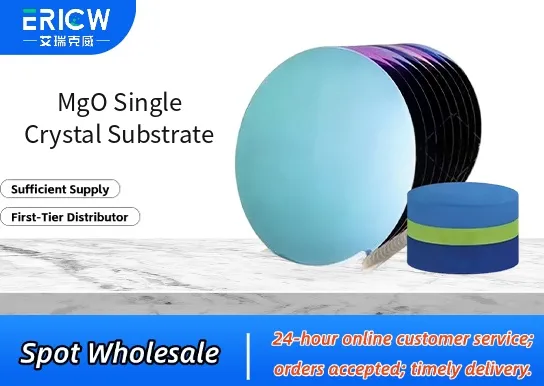
| Chemical Type | Magnesium Oxide (MgO), 99.999% (5N) purity |
| Crystal Structure | Cubic rock-salt (Fm3̄m), single crystal |
| Orientation | (100), (110), or (111) — standard; off-cut options available |
| Dimensions | Typical: 10 × 10 × 0.5 mm³; custom sizes up to Ø 50 mm × 1.0 mm |
| Surface Finish | Double-side polished, epi-ready (Ra < 0.15 nm), optional HF etch + anneal |
| Melting Point | 2852 °C |
| Density | 3.58 g/cm³ |
| Regulatory Compliance | RoHS-compliant; REACH SVHC-free; no listed TSCA or IATA restrictions |
| Common Compatible Systems | Suitability |
| Pulsed Laser Deposition (PLD) systems (e.g., Newport, Coherent) | Highly Recommended – Minimal plasma-induced surface damage; compatible with O₂ ambient up to 10⁻² mbar |
| Molecular Beam Epitaxy (MBE) chambers (e.g., Riber, Veeco) | Highly Recommended – Stable under UHV (<10⁻¹⁰ mbar); withstands in-situ heating to 800 °C without decomposition |
| Sputtering systems (RF/DC magnetron, e.g., Kurt J. Lesker) | Recommended – Requires optimized power density to avoid preferential Mg desorption |
| X-ray Photoelectron Spectroscopy (XPS) & AES analysis platforms | Suitable – Low native carbon contamination; minimal secondary electron yield interference |
Q1: What is the CAS Number for MgO single crystal substrate?
A: The base compound magnesium oxide has CAS No. 1309-48-4; this identifier applies to the bulk material. Individual single crystal substrates are not assigned unique CAS numbers as they are physical forms rather than chemical substances.
Q2: Is MgO substrate subject to extractable or leachable migration in aqueous or acidic environments during device processing?
A: MgO is highly alkaline and slowly hydrolyzes in humid or aqueous conditions, forming Mg(OH)₂. It is not recommended for prolonged exposure to pH < 10 or liquid-phase processing without protective capping. For cleanroom handling, dry N₂ purge and low-humidity storage (<30% RH) are advised.
Q3: How does MgO compare to STO (SrTiO₃) or LSAT (La₀.₃Sr₀.₇Al₀.₆₅Ta₀.₃₅O₃) for oxide heteroepitaxy?
A: MgO offers higher thermal conductivity and better lattice match for certain transition-metal oxides (e.g., NiO, CoO), but lacks the tunable dielectric constant and ferroelectric compatibility of STO or LSAT. Its lower symmetry (cubic vs. pseudo-cubic) simplifies domain control, though it requires careful interfacial engineering for polar-on-nonpolar growth.
Q4: Does your MgO substrate carry ISO 9001 or ISO 14001 certification for manufacturing traceability?
A: Yes — all MgO single crystal substrates are manufactured under ISO 9001:2015 certified processes. Batch-specific certificates of analysis (CoA), including orientation verification (XRD θ–2θ and φ-scans), surface roughness (AFM), and impurity screening (GDMS), are provided upon request.
Contact With Us:
E-mail: wangxingqiang@ericwchem.com
Have a Questions? Call Us:
Add:
Building A1, Jiete Industrial Park, Huangpu District, Guangzhou City, Guangdong Province, China