English
 Español
 tiếng việt
 русский
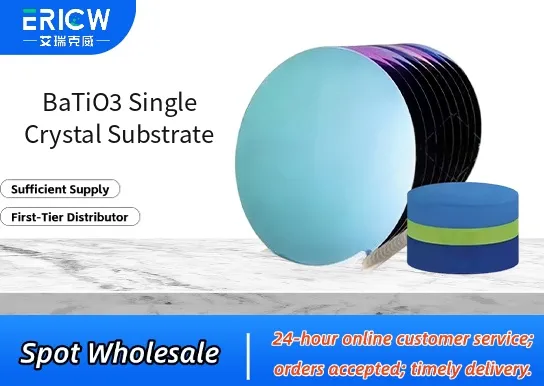
Highly ordered perovskite crystal structure with minimal lattice defects and low dislocation density.
Excellent ferroelectric, piezoelectric, and dielectric properties at room temperature and above Curie point (~120 °C).
Optical transparency in the visible to near-infrared range (400–2500 nm), enabling use in electro-optic devices.
Chemically stable under standard cleanroom handling conditions; resistant to mild aqueous and organic solvents.
Available in precise orientations (e.g., (001), (110), (111)) with surface finish down to <0.2 nm RMS roughness.
Ferroelectric random-access memory (FeRAM) and non-volatile logic device research.
Heteroepitaxial growth platform for complex oxide thin films (e.g., LSMO, LCO, STO).
Electro-optic modulators and tunable photonic integrated circuits.
Piezoelectric micro-electromechanical systems (piezo-MEMS) sensors and actuators.
Model system for fundamental studies of domain dynamics, phase transitions, and strain coupling in perovskites.
| Chemical Type | Barium titanate (BaTiO₃), ultra-high purity (>99.998% metal basis) |
| Product Form | Single-crystal wafer substrate (polished, double-side polished optional) |
| Appearance | Transparent, colorless to pale yellow cubic crystals; mirror-like surface |
| Melting Point | ~1625 °C (decomposes before full melting; peritectic decomposition ~1460 °C) |
| Primary Applications | Research-grade epitaxial growth, ferroelectric device prototyping, optical modulation |
| Key Features | Perovskite symmetry, tetragonal phase at RT, Curie temperature ≈ 120 °C |
| Benefits | Low thermal expansion mismatch with common oxide films; high dielectric constant (εᵣ > 1000 at 1 kHz) |
| Regulatory Compliance | RoHS-compliant; no REACH SVHCs above threshold; SDS available upon request |
| Common Compatible Systems | Suitability |
| Pulsed Laser Deposition (PLD) | Highly Recommended – Excellent stoichiometric transfer and epitaxial registry |
| Molecular Beam Epitaxy (MBE) | Recommended – Requires optimized oxygen partial pressure and substrate heating |
| Sputtering (RF/Magnetron) | Suitable – Compatible with oxide target sputtering; post-annealing often required |
| Atomic Layer Deposition (ALD) | Recommended – Effective for nucleation layers (e.g., TiO₂, Al₂O₃); low-temperature process compatible |
Q1: What is the CAS Registry Number for BaTiO₃?
A: The CAS Number for barium titanate is 12047-27-7.
Q2: Is BaTiO₃ substrate suitable for direct contact with biological or food-contact systems?
A: No — BaTiO₃ single crystals are intended for research and electronic device fabrication only; they are not certified for biomedical implantation or food-contact applications per FDA/EFSA guidelines.
Q3: How does BaTiO₃ compare to SrTiO₃ (STO) as a substrate for oxide heterostructures?
A: BaTiO₃ offers intrinsic ferroelectricity and higher dielectric tunability than non-ferroelectric STO, but STO provides superior lattice match for many transition-metal oxides and greater thermal/chemical stability during high-temperature growth.
Q4: Are there leaching or ion migration concerns when BaTiO₃ substrates are exposed to humid or acidic environments?
A: Under ambient humidity, surface hydroxylation may occur; prolonged exposure to pH <4 solutions can lead to selective barium leaching. For device integration, encapsulation or capping layers are recommended in corrosive processing environments.
Contact With Us:
E-mail: wangxingqiang@ericwchem.com
Have a Questions? Call Us:
Add:
Building A1, Jiete Industrial Park, Huangpu District, Guangzhou City, Guangdong Province, China