English
 Español
 tiếng việt
 русский
Excellent abrasion resistance for extended service life in demanding mechanical environments.
High tensile strength and elongation at break, ensuring superior elasticity and recovery performance.
Good processability via extrusion, injection molding, and calendering without requiring plasticizers.
Outstanding oil, grease, and hydrocarbon resistance compared to conventional thermoplastics.
Transparency and clarity retention after processing, suitable for aesthetic-sensitive applications.
Automotive interior trim components including instrument panel overlays and door panel skins.
High-performance industrial hoses and pneumatic tubing requiring flexibility and pressure resistance.
Consumer electronics protective casings and soft-touch overmolding layers.
Medical-grade non-PVC tubing and fluid-handling components compliant with ISO 10993 biocompatibility guidance.
Sports equipment parts such as grip coatings, gaskets, and wearable device bands.
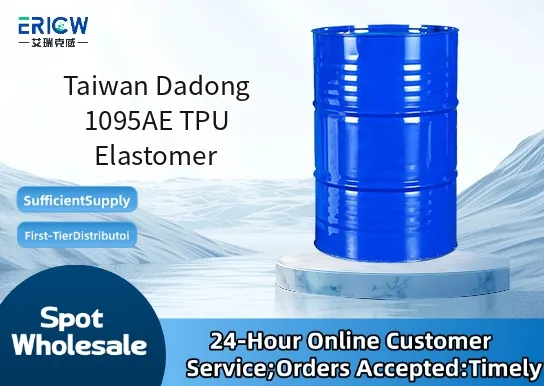
| Chemical Type | Aliphatic polyester-based thermoplastic polyurethane |
| Product Form | Pellets |
| Appearance | Transparent, translucent granules |
| Primary Applications | Overmolding, extrusion profiles, flexible tubing, soft-touch surfaces |
| Key Features | Abrasion resistance, elasticity, clarity, processability, chemical resistance |
| Benefits | Reduced part weight vs. rubber, recyclability, no vulcanization required, consistent melt flow |
| Processing Temperature Range | 180–220 °C (recommended) |
| Storage Conditions | Store in dry, cool environment; desiccate before processing if exposed to humidity |
Q1: What is the primary application niche for Taiwan Dadong 1095AE TPU Elastomer?
A: Taiwan Dadong 1095AE is a thermoplastic polyurethane elastomer specifically engineered for high-performance flexible film and sheet applications—particularly in medical tubing, wearable device components, and soft-touch overmolding where clarity, low compression set, and consistent melt processability are critical.
Q2: How does 1095AE differ from standard aromatic TPU grades in terms of processing behavior?
A: Unlike many conventional aromatic TPUs, 1095AE offers enhanced thermal stability during extrusion and injection molding, with reduced tendency toward yellowing or gel formation at typical processing temperatures. Its optimized molecular architecture supports smoother melt flow and improved die swell control—especially beneficial for thin-gauge films and precision micro-extrusions.
Q3: Is 1095AE suitable for medical-grade applications requiring biocompatibility?
A: While 1095AE is formulated without known cytotoxic additives and complies with general polymer safety guidelines for indirect patient contact, it is not pre-certified to ISO 10993 or USP Class VI. End users must conduct full biocompatibility validation per their specific device design, sterilization method, and regulatory pathway.
Q4: Can 1095AE be blended or alloyed with other polymers?
A: Yes—1095AE demonstrates good compatibility with select polyesters, polycarbonates, and certain modified polyolefins when used as a toughening or flexibility modifier. However, prior compatibility testing—including morphology analysis and mechanical property evaluation—is strongly recommended before scaling up any alloy formulation.
Contact With Us:
E-mail: wangxingqiang@ericwchem.com
Have a Questions? Call Us:
Add:
Building A1, Jiete Industrial Park, Huangpu District, Guangzhou City, Guangdong Province, China