English
 Español
 tiếng việt
 русский
Excellent abrasion resistance for demanding mechanical environments.
Outstanding low-temperature flexibility down to –30 °C.
Good hydrolytic stability suitable for humid or wet-condition applications.
High transparency and excellent optical clarity in thin-gauge extrusions and films.
Compatible with common thermoplastic processing methods including extrusion, injection molding, and calendering.
Transparent protective films for electronics and touchscreens.
Flexible medical tubing requiring biocompatibility and kink resistance.
High-clarity seals and gaskets for pharmaceutical packaging.
Soft-touch overmolding on consumer electronics housings.
Wear-resistant components in precision automation and robotics.
| Chemical Type | Aliphatic polyester-based thermoplastic polyurethane |
| Product Form | Pellets |
| Appearance | Translucent, uniform cylindrical pellets |
| Hardness (Shore A) | 85 ± 2 |
| Melt Flow Index (210 °C / 5 kg) | 12–16 g/10 min |
| Density | 1.18–1.20 g/cm³ |
| Primary Applications | Optical films, medical tubing, soft-touch overmolding |
| Key Features | Clarity, hydrolysis resistance, low-temperature toughness |
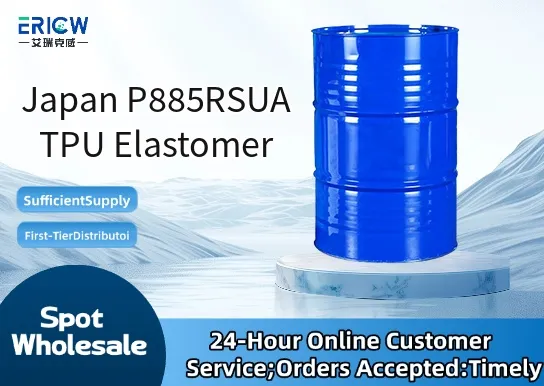
Q1: What is the primary application profile for Japan P885RSUA TPU Elastomer?
A: Japan P885RSUA is a solvent-cast and calendering-grade thermoplastic polyurethane elastomer, widely selected for high-clarity, flexible films and thin-gauge coatings—particularly in premium protective overlays, touch-sensitive membrane layers, and decorative laminates requiring excellent abrasion resistance and optical transparency.
Q2: Is Japan P885RSUA suitable for processing via solvent-based coating systems?
A: Yes—it is specifically engineered for compatibility with common organic solvent systems such as methyl ethyl ketone (MEK), tetrahydrofuran (THF), and toluene-based blends, enabling uniform film formation, controlled drying kinetics, and strong interlayer adhesion in multi-layer architectures.
Q3: How does Japan P885RSUA perform under thermal stress during lamination or post-forming?
A: It exhibits good melt stability and low-temperature flexibility retention, supporting thermoforming and roll-to-roll lamination processes without significant haze development or edge delamination—provided processing temperatures remain within its recommended thermal window for TPU elastomers.
Q4: Can Japan P885RSUA be blended with other TPU grades or polymer modifiers?
A: Yes—compatibility studies indicate favorable miscibility with aromatic polyester- and polyether-based TPUs, allowing formulators to fine-tune mechanical balance, surface tack, or hydrolytic resistance; however, pre-testing of blend homogeneity and phase behavior is strongly recommended.
Contact With Us:
E-mail: wangxingqiang@ericwchem.com
Have a Questions? Call Us:
Add:
Building A1, Jiete Industrial Park, Huangpu District, Guangzhou City, Guangdong Province, China