English
 Español
 tiếng việt
 русский
High chromatic strength with excellent tinting power in both aqueous and solvent-based systems.
Outstanding lightfastness (ISO 105-B02: Grade 7–8) and weather resistance for long-term color stability.
Good thermal stability up to 220 °C, suitable for medium-temperature processing applications.
Low volatility and negligible migration in polymer matrices, ensuring compliance with regulatory requirements for general industrial use.
Consistent particle size distribution for uniform dispersion and minimal filter clogging during production.
Automotive coatings (basecoats and clearcoat tints).
Industrial maintenance paints and coil coatings.
Plastic coloration for ABS, PS, and PVC compounds.
Offset and gravure inks for packaging and commercial printing.
Architectural and decorative wall paints.
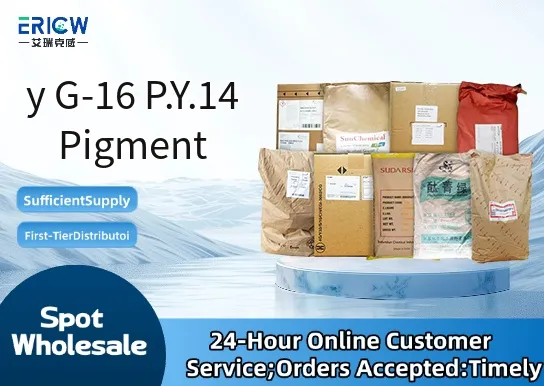
| Chemical Type | Azo pigment (Pigment Yellow 14) |
| Product Form | Fine free-flowing powder |
| Appearance | Bright greenish-yellow powder |
| Primary Applications | Coatings, plastics, inks |
| Key Features | High opacity, good dispersibility, low oil absorption |
| Benefits | Cost-effective colorant with balanced performance across multiple media |
| Regulatory Status | REACH compliant; no SVHCs above threshold |
| Storage Conditions | Store in cool, dry place away from direct sunlight and moisture |
Q1: What is the primary chemical class and typical hue profile of y G-16 P.Y.14 Pigment?
A: y G-16 P.Y.14 is an organic monoazo pigment classified under the PY.14 (Pigment Yellow 14) series, known for its bright, greenish-yellow shade with strong tinting strength and good opacity in most polymer and coating systems.
Q2: Is y G-16 P.Y.14 suitable for use in food-contact plastics or toys?
A: This pigment is not pre-approved for direct food-contact or toy applications under major regulatory frameworks unless specifically validated by the end-user’s compliance team. It may be considered for non-migrating applications where extraction risk is minimized, but formal regulatory clearance must be obtained case by case.
Q3: How does y G-16 P.Y.14 perform in terms of thermal stability during processing?
A: It exhibits moderate thermal stability, generally supporting standard extrusion and injection molding conditions for polyolefins and PVC up to approximately 200–220 °C, depending on residence time and matrix compatibility. Extended high-temperature exposure may lead to slight shade shift or reduced intensity.
Q4: What dispersion methods are recommended for optimal color development in solvent-based coatings?
A: High-shear dispersion using suitable dispersing agents—such as polymeric or acidic stabilizers—is recommended. Pre-dispersed pastes or let-down formulations often yield better consistency than dry powder addition. Optimal results are typically achieved with bead milling or high-speed dissolvers.
Q5: Can y G-16 P.Y.14 be used in combination with other pigments without significant interaction risks?
A: Yes, it is generally compatible with common inorganic and organic pigments in multi-pigment systems, including iron oxides and phthalocyanines. However, formulation-specific testing is advised to confirm absence of flocculation, shade drift, or reduced gloss in final applications.
Contact With Us:
E-mail: wangxingqiang@ericwchem.com
Have a Questions? Call Us:
Add:
Building A1, Jiete Industrial Park, Huangpu District, Guangzhou City, Guangdong Province, China