English
 Español
 tiếng việt
 русский
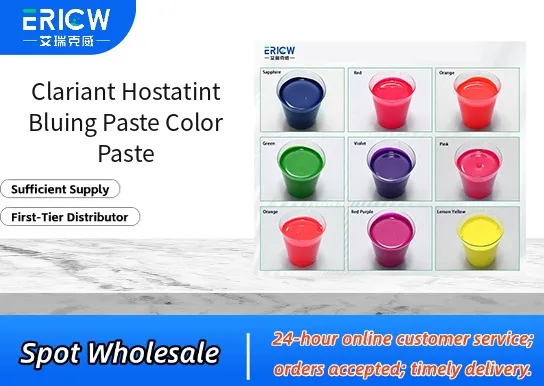
Highly concentrated, solvent-free bluing paste for precise shade control in textile and detergent applications.
Excellent lightfastness and washfastness, ensuring consistent blue tone retention after repeated laundering.
Compatible with anionic, nonionic, and cationic surfactant systems without compromising stability or performance.
Low migration tendency—minimizes staining of adjacent fibers or substrates during processing and storage.
EcoVadis-verified sustainable formulation aligned with Clariant’s EcoTain® portfolio principles.
Laundry detergents (powder, liquid, and pod formats) for optical brightening and whiteness enhancement.
Textile finishing of cotton, polyester-cotton blends, and regenerated cellulose fabrics.
Industrial cleaning formulations requiring controlled blue toning to counteract yellowing.
Carpet and upholstery cleaning agents where color fidelity and substrate safety are critical.
Personal care cleansing products (e.g., shampoos, body washes) formulated for whitening or toning effects.
| Chemical Type | Reactive disazo pigment dispersion |
| Product Form | Viscous, non-drip paste |
| Appearance | Deep blue, homogeneous paste |
| Primary Applications | Whitening agents in detergents and textile auxiliaries |
| Key Features | High tinctorial strength, pH-stable (pH 5–10), low heavy metal content |
| Benefits | Reduced dosage requirements, improved process efficiency, REACH-compliant |
| Storage Stability | ≥12 months at 5–25°C in sealed original packaging |
| Recommended Dosage | 0.05–0.3% w/w based on final formulation |
Q1: What is the primary function of Hostatint Bluing Paste in polymer applications?
A: Hostatint Bluing Paste is a specialized optical brightener and bluing agent designed to neutralize yellowish undertones and enhance whiteness in thermoplastic polymers—particularly polyolefins such as PP and PE—during compounding or masterbatch production.
Q2: Is this paste compatible with high-temperature processing conditions?
A: Yes, Hostatint Bluing Paste is formulated for thermal stability during standard polymer processing operations including extrusion, injection molding, and blow molding. It maintains performance across typical melt temperature ranges for polyolefins without significant degradation or color shift.
Q3: How is dosage typically determined for optimal bluing effect?
A: Dosage depends on the base polymer’s inherent yellowness, desired shade intensity, and processing history. It is generally used at low concentrations—typically ranging from 0.1% to 2% by weight in masterbatches—and should be optimized via small-scale trials under representative processing conditions.
Q4: Can Hostatint Bluing Paste be used in food-contact or medical-grade polymers?
A: While the paste is designed for technical polymer applications, regulatory compliance for food contact or medical use depends on final formulation, processing parameters, and regional requirements. Customers must conduct full regulatory assessment—including migration evaluation—based on their specific end-use and applicable legislation.
Contact With Us:
E-mail: wangxingqiang@ericwchem.com
Have a Questions? Call Us:
Add:
Building A1, Jiete Industrial Park, Huangpu District, Guangzhou City, Guangdong Province, China