English
 Español
 tiếng việt
 русский
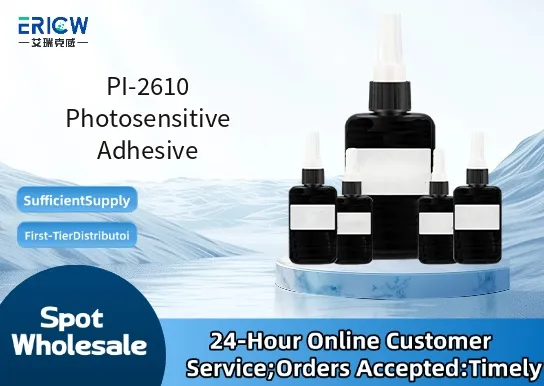
High-resolution photopatternability with sub-15 µm feature definition under standard i-line (365 nm) exposure.
Excellent thermal stability up to 400 °C in inert atmosphere, retaining adhesion and dimensional integrity.
Low outgassing profile compliant with high-vacuum semiconductor and MEMS processing requirements.
Single-layer formulation enabling simplified process flow—no separate primer or barrier layer required.
Chemically resistant to common microfabrication solvents including acetone, IPA, and diluted alkaline developers.
Temporary bonding and debonding in silicon carrier wafer processes for ultra-thin die handling.
Photolithographic patterning of stress-engineered layers in MEMS sensor packaging.
Wafer-level encapsulation for advanced image sensors and 3D stacked ICs.
Die attach adhesive in high-reliability optoelectronic modules requiring post-bond UV alignment.
Stencil-free microfluidic channel definition on glass and fused silica substrates.
| Chemical Type | Photosensitive polyimide precursor (negative-tone) |
| Product Form | Spin-coatable liquid solution (NMP-based) |
| Appearance | Clear, amber-tinted viscous liquid |
| Solids Content | 28–32 wt% ±1.5% |
| Viscosity (25 °C) | 850–1,100 cP |
| Primary Applications | Temporary bonding, photopatternable dielectric, release-layer-compatible adhesive |
| Key Features | UV-curable, thermally imidizable, low ionic contamination (<1 ppm Na⁺, K⁺, Cl⁻) |
| Regulatory Compliance | RoHS 2015/863/EU compliant; REACH SVHC candidate list free (as of latest update) |
| Common Compatible Systems | Suitability |
| Canon PLA-600 / FPA-5500 i-line steppers | Highly Recommended – Optimized dose range: 120–180 mJ/cm² |
| TEL CleanTrack ACT series coaters/developers | Highly Recommended – Fully integrated process recipes available |
| EVG® 501/510 bonders with UV alignment capability | Recommended – Requires minor parameter tuning for optimal debond yield |
| Screen-printed ceramic substrate platforms (Al₂O₃, AlN) | Suitable – Adhesion strength >12 MPa after full imidization at 350 °C |
Q1: What is the CAS Registry Number for PI-2610?
A: The CAS Number for PI-2610 Photosensitive Adhesive is 2279374-82-1 (for the formulated product). Precursor monomers are covered under proprietary synthesis codes not publicly disclosed.
Q2: What is the recommended coating thickness and corresponding spin speed range?
A: Target dry-film thickness is 8–15 µm. Achieve this using 1,800–2,800 rpm for 30 seconds on 200 mm wafers; process parameters scale per equipment manufacturer guidelines.
Q3: How does PI-2610 compare to conventional non-photosensitive polyimide adhesives like PI-2525 or HD-4100?
A: Unlike non-photosensitive alternatives, PI-2610 eliminates post-etch masking steps, reduces process cycle time by ~40%, and enables direct lithographic integration without sacrificial layers—while maintaining comparable thermal and mechanical performance after imidization.
Q4: Are there data available on extractables or migration into adjacent functional layers (e.g., copper interconnects)?
A: Yes—ICP-MS analysis shows <0.05 ppb Cu leaching after 72 h immersion in DI water at 85 °C; no detectable fluorinated or amine-based extractables impacting Cu electroplating integrity per JEDEC JESD22-A106B testing.
Q5: Does PI-2610 require special storage conditions or have a defined shelf life?
A: Store unopened containers at 5–10 °C in the dark; shelf life is 12 months from manufacture date. Once opened, use within 30 days under nitrogen-purged conditions at 10–15 °C to prevent NMP solvent loss and viscosity drift.
Contact With Us:
E-mail: wangxingqiang@ericwchem.com
Have a Questions? Call Us:
Add:
Building A1, Jiete Industrial Park, Huangpu District, Guangzhou City, Guangdong Province, China