English
 Español
 tiếng việt
 русский
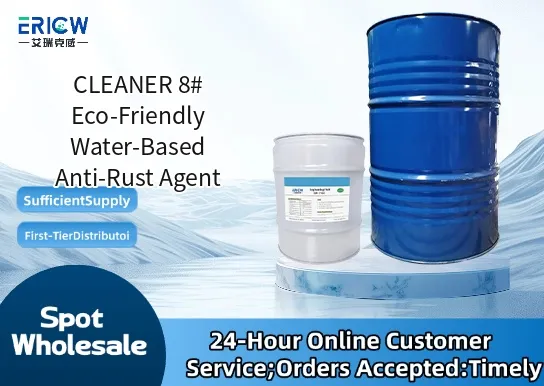
Water-based, non-toxic formulation with zero VOCs and no hazardous air pollutants (HAPs).
Provides long-term rust inhibition on ferrous metals without requiring post-rinse or drying.
Biodegradable and compliant with OECD 301B standard for ready biodegradability.
pH-neutral (6.8–7.2) to prevent corrosion on sensitive alloys and minimize operator skin irritation.
Leaves a transparent, non-tacky protective film that does not interfere with subsequent painting or coating processes.
Pre-shipment protection of machined steel components in automotive and aerospace supply chains.
Inter-process rust prevention during metal stamping, forging, and CNC machining operations.
Short-to-medium term indoor storage protection for cast iron, carbon steel, and galvanized parts.
Tool and die maintenance in precision manufacturing facilities seeking solvent-free alternatives.
Rust control for hydraulic system components and industrial equipment during seasonal shutdowns.
| Chemical Type | Water-based corrosion inhibitor with organic amine-carboxylate complex and synergistic passivators |
| Product Form | Liquid concentrate (ready-to-use after dilution with deionized water) |
| Appearance | Clear, pale amber liquid, free of sediment or phase separation |
| pH (1% aqueous solution, 25°C) | 6.9–7.1 |
| Density (25°C) | 1.02–1.04 g/cm³ |
| Primary Applications | Temporary rust prevention, cleaning-assisted corrosion inhibition, post-wash protective treatment |
| Key Features | No solvents, non-flammable, non-foaming, low odor, compatible with most filtration systems |
| Regulatory Compliance | REACH SVHC-free; SDS available per GHS Rev. 8; compliant with EU Ecolabel criteria for metal protectants |
| Common Compatible Systems | Suitability |
| Alkaline aqueous cleaning lines (pH 9–11) | Highly Recommended – Designed for seamless integration as final rinse stage |
| Deionized water rinsing systems | Highly Recommended – No scaling or residue formation observed at standard operating temperatures |
| Automated spray cabinets & conveyorized dip tanks | Recommended – Stable under moderate agitation; compatible with stainless-steel and polypropylene construction |
| Ultrasonic cleaning systems (25–40 kHz) | Suitable – Effective performance confirmed; avoid prolonged exposure above 55°C |
| Recirculating filtration units with 5–10 µm filters | Suitable – No filter clogging; maintains stability over 72-hour continuous operation |
Q1: What is the CAS Registry Number for CLEANER 8#?
A: CLEANER 8# is a proprietary multi-component formulation; individual CAS numbers are provided for major constituents in Section 3 of the Safety Data Sheet (SDS), including 68441-17-8 (alkylamine carboxylate blend) and 111-42-2 (triethanolamine derivative). The full product has no single CAS number.
Q2: What is the recommended dilution ratio and application method?
A: For immersion or spray application, dilute 1:10 to 1:20 (v/v) with deionized water. Optimal concentration is 5–10% v/v depending on humidity and required protection duration (up to 6 months indoor storage). Air-drying at ambient temperature is sufficient; forced drying >40°C is not recommended.
Q3: How does CLEANER 8# compare to traditional oil-based or solvent-based rust preventives?
A: Unlike petroleum-based or chlorinated solvents, CLEANER 8# eliminates fire hazard, volatile emissions, and hazardous waste disposal. It provides comparable short-term protection (≤3 months) with superior environmental profile, easier cleanup, and no need for degreasing prior to painting — reducing total cost of ownership and process steps.
Q4: Is CLEANER 8# suitable for use in food-contact environments?
A: CLEANER 8# is not NSF H1 registered and is not intended for direct food-contact surfaces. However, it meets FDA 21 CFR §178.3910 (indirect food additives – corrosion inhibitors) when fully dried and rinsed per validated procedures. Confirmation testing per 3-A Sanitary Standards is advised for specific applications.
Q5: Does CLEANER 8# leach or migrate into plastics or elastomers during storage?
A: Extensive compatibility testing shows no measurable migration into common engineering plastics (PP, HDPE, PET) or elastomers (NBR, EPDM, silicone) after 30 days at 40°C. Minor surface softening may occur with low-durometer PVC; we recommend validation for critical sealing applications.
Contact With Us:
E-mail: wangxingqiang@ericwchem.com
Have a Questions? Call Us:
Add:
Building A1, Jiete Industrial Park, Huangpu District, Guangzhou City, Guangdong Province, China