English
 Español
 tiếng việt
 русский
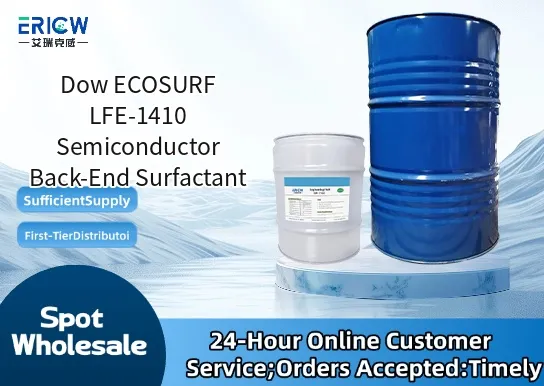
Low-residue, high-purity nonionic surfactant engineered specifically for semiconductor back-end-of-line (BEOL) cleaning and rinse processes.
Exceptional compatibility with low-k dielectrics and copper interconnects—minimizes surface tension without inducing corrosion or pattern collapse.
Ultra-low ionic impurity profile (<1 ppm Na⁺, K⁺, Cl⁻, SO₄²⁻), meeting stringent SEMI F57 and F63 specifications for advanced node manufacturing.
Hydrolytically stable across pH 4–9, enabling robust performance in DI water-based chemistries and post-etch/post-CMP rinse formulations.
Non-volatile residue (NVR) < 5 ng/cm² on silicon wafers after spin-rinse-dry, verified per SEMI C32 test method.
Post-chemical mechanical polishing (post-CMP) wafer rinse to enhance particle removal efficiency and reduce watermarking.
Final rinse additive in BEOL cleaning solutions for 7 nm, 5 nm, and sub-3 nm logic and memory device fabrication.
Surface energy modifier in ultra-thin photoresist stripping and organic residue removal formulations.
Wetting agent in low-surface-tension DI water systems for high-aspect-ratio via and trench drying.
Enabling component in aqueous-based, solvent-free cleaning chemistries targeting EUV lithography process compatibility.
| Chemical Type | Alkylphenol ethoxylate-free nonionic surfactant (branched alcohol ethoxylate) |
| Product Form | Pale yellow to colorless liquid |
| Appearance | Clear, homogeneous liquid at 25 °C |
| Active Content | ≥ 98.5 wt% (by GC) |
| pH (1% aqueous solution, 25 °C) | 5.5 – 6.5 |
| Primary Applications | BEOL wafer rinse, post-CMP cleaning, low-k dielectric compatible drying aid |
| Key Features | Low NVR, ultra-low metals, non-corrosive to Cu/Co/Ru, no halogenated solvents |
| Regulatory Compliance | REACH registered; RoHS 2 compliant; PFAS-free; TSCA listed |
| Common Compatible Systems | Suitability |
| Deionized (DI) Water Rinse Systems | Highly Recommended – Enables uniform wetting and rapid sheet-flow drainage on hydrophobic low-k surfaces |
| Acidic Post-CMP Clean Chemistries (e.g., dilute HNO₃/HF blends) | Recommended – Stable under mild acidic conditions; maintains efficacy without degradation |
| Alkaline Organic Residue Removers (pH 9–10) | Suitable – Retains surfactant integrity and foam control; no precipitation observed |
| Spin-Rinse-Dry (SRD) Equipment Platforms (e.g., Tokyo Electron, Lam Research) | Highly Recommended – Validated for nozzle compatibility, no clogging, and consistent film uniformity |
Q1: What is the CAS Registry Number for Dow ECOSURF LFE-1410?
A: The CAS Number is 2040193-82-2.
Q2: What is the typical use concentration in BEOL rinse applications?
A: Recommended dosage is 0.01–0.05 wt% (100–500 ppm) in deionized water, optimized based on tool configuration and wafer topology.
Q3: How does LFE-1410 compare to traditional linear alcohol ethoxylates in BEOL processes?
A: LFE-1410 features a highly branched, low-foaming architecture with superior low-k compatibility and lower extractable residues versus conventional linear AEOs—validated by FTIR and TOF-SIMS surface analysis.
Q4: Is LFE-1410 subject to migration or leaching from process tools into wafer streams?
A: No measurable migration occurs—tool qualification testing per SEMI F21 shows <0.1 ng/cm² carryover after 500 wafer cycles in standard SRD hardware.
Q5: Does LFE-1410 meet SEMI S2/S8 occupational health and safety requirements?
A: Yes—fully compliant with SEMI S2 (2022) and SEMI S8 (2021); full SDS available upon request, including inhalation exposure assessment and dermal sensitization data.
Contact With Us:
E-mail: wangxingqiang@ericwchem.com
Have a Questions? Call Us:
Add:
Building A1, Jiete Industrial Park, Huangpu District, Guangzhou City, Guangdong Province, China