English
 Español
 tiếng việt
 русский
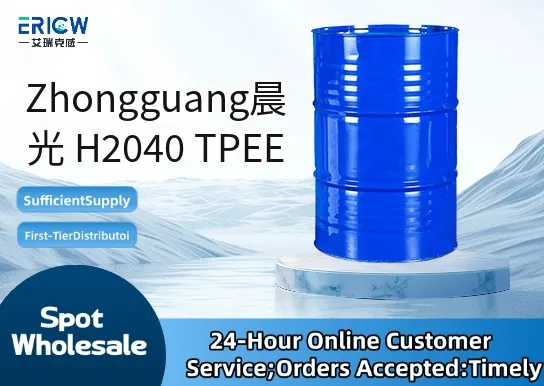
Excellent balance of thermoplastic processability and elastomeric performance.
High tensile strength and outstanding resilience at elevated temperatures.
Good resistance to oils, greases, and common industrial chemicals.
Low compression set and superior long-term dynamic fatigue resistance.
Compatible with standard thermoplastic processing equipment (injection molding, extrusion, blow molding).
Automotive under-hood components including air ducts and sensor housings.
Industrial hydraulic and pneumatic seals and gaskets.
High-performance sporting goods such as ski bindings and bicycle suspension parts.
Consumer electronics casings requiring impact resistance and dimensional stability.
Medical tubing and connectors requiring biocompatibility-supporting formulation.
| Chemical Type | Thermoplastic Polyester Elastomer (TPEE) |
| Product Form | Natural granules |
| Appearance | Off-white, semi-crystalline pellets |
| Primary Applications | Dynamic mechanical parts, seals, flexible structural components |
| Key Features | High modulus, thermal stability up to 150 °C short-term |
| Benefits | Reduced part weight vs. thermoset rubber; recyclable and reprocessable |
| Processing Method | Injection molding, extrusion, blow molding |
| Standard Packaging | 25 kg multi-layer moisture-proof bag in cardboard drum |
Q1: What are the key processing advantages of Zhongguang H2040 TPEE compared to conventional thermoplastic elastomers?
A: Zhongguang H2040 TPEE offers excellent melt processability via extrusion and injection molding, with faster cycle times than many polyester-based TPEEs due to its balanced crystallinity and thermal stability. It exhibits low melt viscosity at processing temperatures and good dimensional stability in finished parts.
Q2: Is H2040 suitable for applications requiring resistance to oils, greases, and common industrial fluids?
A: Yes — as a thermoplastic polyester elastomer, H2040 delivers inherently superior resistance to non-polar substances such as mineral oils, aliphatic hydrocarbons, and many greases, outperforming most TPU and TPO grades in these environments.
Q3: Can H2040 be blended or co-processed with other polymers?
A: H2040 demonstrates good compatibility with certain polyesters (e.g., PET, PBT) and engineering thermoplastics when used as a toughening modifier. Compatibility with polar resins should be verified experimentally; it is generally not recommended for blending with non-polar polymers like PP or PE without compatibilization.
Q4: How does H2040 perform under repeated flexing or dynamic mechanical stress?
A: Thanks to its phase-separated morphology and robust hard-segment domains, H2040 maintains high resilience and fatigue resistance over extended cyclic loading — making it well-suited for dynamic sealing, flexible couplings, and repeatedly actuated components.
Contact With Us:
E-mail: wangxingqiang@ericwchem.com
Have a Questions? Call Us:
Add:
Building A1, Jiete Industrial Park, Huangpu District, Guangzhou City, Guangdong Province, China