English
 Español
 tiếng việt
 русский
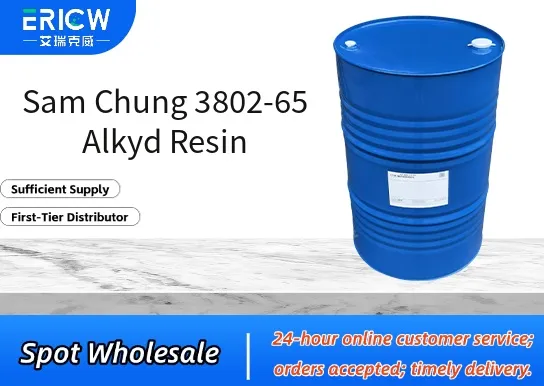
Medium-oil-length alkyd resin offering balanced drying speed and film flexibility.
Excellent compatibility with nitrocellulose, vinyl, and acrylic co-resins for hybrid formulations.
High gloss retention and superior clarity in clear coat applications.
Good solubility in common aromatic and ketonic solvents (e.g., xylene, MEK, acetone).
Low viscosity grade enabling high-solids formulation without excessive thinning.
Automotive refinish clear coats and basecoat/clearcoat systems.
Industrial maintenance coatings for metal furniture and agricultural equipment.
General-purpose decorative enamels for interior and exterior architectural trim.
Wood finishing varnishes requiring fast through-dry and sandable surface.
Can coatings for non-food-contact metal containers and closures.
| Chemical Type | Medium-oil modified phthalic alkyd resin |
| Product Form | Liquid, solvent-borne |
| Appearance | Clear, pale yellow to amber viscous liquid |
| Non-Volatile Content (wt%) | 55–58% (at 105°C, 60 min) |
| Viscosity (25°C, Brookfield RVT, #4 spindle, 20 rpm) | 1,200–1,800 cP |
| Acid Value (mg KOH/g) | 6–9 |
| Solubility | Readily soluble in xylene, toluene, MEK, acetone, and ester blends |
| Recommended Diluent | Aromatic hydrocarbons or ketone/ester mixtures |
Q1: What is the primary application field for Sam Chung 3802-65 Alkyd Resin?
A: Sam Chung 3802-65 is a medium-oil-length alkyd resin designed primarily for solvent-based industrial maintenance coatings, general-purpose enamels, and protective topcoats where good gloss retention, through-dry performance, and compatibility with common organic solvents are required.
Q2: Is this resin suitable for use in high-solids coating formulations?
A: Yes — 3802-65 offers favorable viscosity-to-solids ratio and can be formulated into high-solids systems when combined with appropriate reactive diluents or low-VOC solvents. Its molecular structure supports reduced solvent demand without compromising film formation or flow characteristics.
Q3: How does Sam Chung 3802-65 compare to long-oil alkyds in terms of drying speed and hardness development?
A: As a medium-oil alkyd, 3802-65 provides faster through-dry and earlier hardness build than long-oil variants, while maintaining better flexibility and yellowing resistance than short-oil resins. It strikes a practical balance for applications requiring both reasonable cure speed and mechanical durability.
Q4: Can this resin be modified or crosslinked with other chemistries?
A: Yes — 3802-65 contains reactive sites that allow effective modification with melamine-formaldehyde resins, urea-formaldehyde systems, or polyisocyanates for enhanced chemical resistance and thermal stability. Compatibility testing under intended formulation conditions is recommended prior to full-scale implementation.
Q5: What solvent systems is Sam Chung 3802-65 typically compatible with?
A: It demonstrates excellent solubility and stability in standard aromatic and aliphatic hydrocarbon blends (e.g., xylene, Solvesso™ types), as well as ketones and esters. Avoid prolonged exposure to strong protic solvents such as low-molecular-weight alcohols, which may induce viscosity instability.
Contact With Us:
E-mail: wangxingqiang@ericwchem.com
Have a Questions? Call Us:
Add:
Building A1, Jiete Industrial Park, Huangpu District, Guangzhou City, Guangdong Province, China