English
 Español
 tiếng việt
 русский
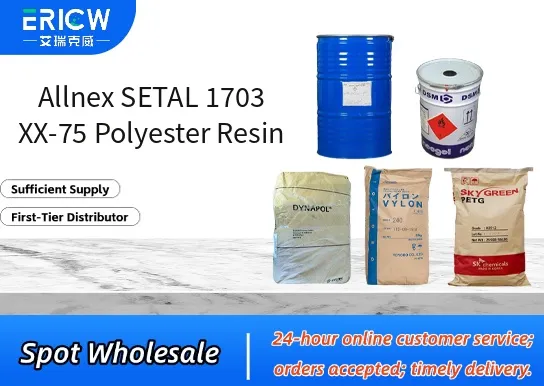
High-solids, low-VOC polyester resin designed for energy-efficient curing.
Excellent flow and leveling characteristics for smooth, defect-free film formation.
Good compatibility with melamine formaldehyde crosslinkers and common solvent blends.
Enhanced hydrolytic stability for improved storage life and formulation robustness.
Consistent batch-to-batch performance supported by Allnex’s stringent quality control.
Automotive OEM clearcoats and basecoat/clearcoat systems.
Industrial maintenance coatings for metal substrates.
General-purpose coil coatings requiring good formability and corrosion resistance.
Powder coating hybrid formulations (liquid-powder hybrid or low-bake variants).
High-performance appliance finishes for refrigerators, washing machines, and HVAC units.
| Chemical Type | Saturated polyester resin |
| Product Form | Liquid (solution in aromatic and aliphatic solvents) |
| Appearance | Clear, pale yellow liquid |
| Solids Content (wt%) | 75 ± 1% |
| Acid Value (mg KOH/g) | 12–16 |
| Hydroxyl Value (mg KOH/g) | 85–95 |
| Viscosity (25°C, mPa·s) | 4,500–6,500 |
| Density (25°C, g/cm³) | 1.08–1.12 |
Q1: What is the primary application field for SETAL 1703 XX-75?
A: SETAL 1703 XX-75 is a high-solids, low-viscosity unsaturated polyester resin designed primarily for solventborne industrial coatings, including coil and can coatings where excellent gloss retention, hardness development, and chemical resistance are required.
Q2: Is SETAL 1703 XX-75 compatible with common crosslinkers used in industrial baking systems?
A: Yes, it is formulated to react efficiently with standard amino resins—particularly melamine-formaldehyde types—under conventional thermal cure conditions, enabling robust film formation and good overbake stability.
Q3: How does SETAL 1703 XX-75 perform in terms of storage stability and viscosity control?
A: The resin exhibits good shelf life under recommended storage conditions (cool, dry, and protected from moisture), and its low initial viscosity supports easy handling and high-solids formulation without excessive thinning agents.
Q4: Can SETAL 1703 XX-75 be used in food-contact coatings?
A: While the base polymer structure is suitable for certain food-can applications, final regulatory compliance depends on the complete formulation—including crosslinker, catalyst, and additives—as well as processing conditions and end-use requirements. Formulators must conduct full regulatory validation for intended food-contact use.
Contact With Us:
E-mail: wangxingqiang@ericwchem.com
Have a Questions? Call Us:
Add:
Building A1, Jiete Industrial Park, Huangpu District, Guangzhou City, Guangdong Province, China