English
 Español
 tiếng việt
 русский
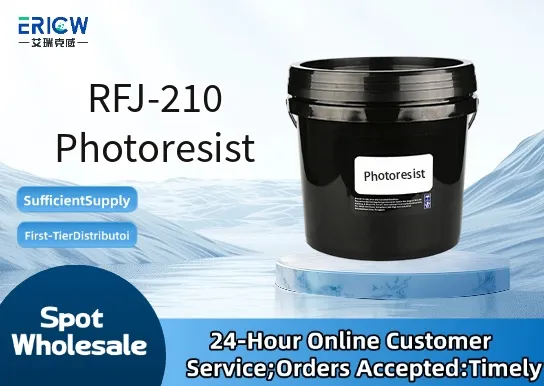
High-resolution patterning capability with sub-micron resolution down to 0.8 µm under standard i-line exposure (365 nm).
Excellent thermal stability up to 140 °C post-bake, minimizing pattern deformation during downstream processing.
Low outgassing profile suitable for vacuum-compatible lithography tools and MEMS fabrication environments.
Optimized adhesion to silicon, SiO₂, and metal substrates without requiring specialized primers.
Consistent performance across wafer batches with tight CD uniformity control (3σ ≤ ±3.5% of target line width).
Front-end semiconductor manufacturing for gate-level and interconnect layer patterning.
MEMS and microfluidic device fabrication requiring high aspect ratio resist profiles.
Advanced packaging applications including fan-out wafer-level packaging (FOWLP) redistribution layers.
Photomask repair and direct-write maskless lithography processes.
Research & development in nanoscale patterning labs using stepper and contact aligners.
| Chemical Type | Positive-tone novolac-diazonaphthoquinone (DNQ) photoresist |
| Product Form | Liquid solution (spin-coatable), supplied in amber HDPE bottles |
| Appearance | Clear, light yellow to amber viscous liquid |
| Viscosity (25 °C) | 22–24 cP (measured per ASTM D445) |
| Solids Content | 27.5–28.5 wt% (by gravimetric analysis) |
| Primary Applications | i-line (365 nm) lithography for 0.8–3.0 µm feature sizes |
| Key Features | High photospeed (~40 mJ/cm²), low standing wave effect, minimal swelling in aqueous developers |
| Regulatory Compliance | REACH SVHC-free; RoHS 2015/863 compliant; no intentionally added PFAS |
| Common Compatible Systems | Suitability |
| Canon FPA-3030i5a Stepper | Highly Recommended – Validated for full-field exposure at 365 nm with <1.5% CD variation |
| Karlsuss MA6 Mask Aligner | Recommended – Requires optimized soft/hard bake profile and proximity gap adjustment |
| TOK TOK-1000 Spin Coater | Highly Recommended – Pre-programmed recipe available; uniformity <2.0% (3σ) |
| Technics T-300 Developer System | Suitable – Compatible with 0.26 N TMAH developer; rinse time optimized for minimal residue |
Q1: What is the CAS Registry Number for RFJ-210 Photoresist?
A: RFJ-210 is a proprietary multi-component formulation; individual CAS numbers are assigned only to its major constituents (e.g., novolac resin: CAS 9003-35-4; DNQ sensitizer: CAS 82-08-6). Full compositional disclosure requires signed CDA.
Q2: What is the typical coating thickness and recommended spin speed range?
A: At 3000 rpm, achieves 1.2 ± 0.05 µm dry film thickness on bare Si wafers; optimal spin speed range is 2500–4000 rpm depending on desired thickness (0.9–1.8 µm).
Q3: How does RFJ-210 compare to RFJ-180 in terms of resolution and process window?
A: RFJ-210 offers higher resolution (≤0.8 µm vs. ≥1.2 µm for RFJ-180) and wider focus latitude (±0.4 µm vs. ±0.2 µm), but requires tighter temperature control during PAB due to higher DNQ loading.
Q4: Is RFJ-210 compliant with ISO 10993 or USP Class VI for biomedical device patterning?
A: RFJ-210 is not certified to ISO 10993 or USP Class VI. It is intended for industrial semiconductor/MEMS use only; residual monomer extraction testing data is available under NDA for qualifying R&D programs.
Q5: Are there known extractables or leachables when RFJ-210 is used on stainless steel or glass substrates in wet etch environments?
A: No significant leachables observed in IPA or DI water rinses (LC-MS detection limit <1 ppm); however, prolonged immersion (>10 min) in concentrated HF-based etchants may cause partial resist lift-off—use only with verified hard-bake protocols.
Contact With Us:
E-mail: wangxingqiang@ericwchem.com
Have a Questions? Call Us:
Add:
Building A1, Jiete Industrial Park, Huangpu District, Guangzhou City, Guangdong Province, China