English
 Español
 tiếng việt
 русский
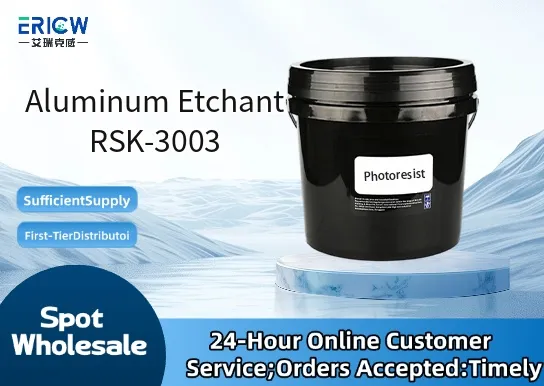
Highly selective etching for aluminum and aluminum alloys with minimal undercut or surface pitting.
Non-hydrofluoric acid (HF-free) formulation ensuring enhanced workplace safety and reduced regulatory burden.
Stable performance across a wide operating temperature range (20–50 °C) without requiring continuous replenishment.
Low foaming and excellent wetting characteristics for uniform etch rates on complex geometries and microstructures.
Compatible with standard stainless steel and polypropylene process equipment—no special material lining required.
Pre-treatment for anodizing, especially in architectural and aerospace aluminum extrusions.
Surface activation prior to adhesive bonding or paint coating in automotive trim manufacturing.
Micro-roughening of aluminum heat sink substrates for improved thermal interface material adhesion.
Removal of native oxide layers in precision microelectronics packaging substrates.
Controlled thin-film removal in optical component finishing and reflective surface preparation.
| Chemical Type | Aqueous acidic blend (phosphoric–nitric–acetic acid system) |
| Product Form | Liquid concentrate (ready-to-dilute) |
| Appearance | Clear, pale amber liquid |
| pH (10% v/v aqueous solution at 25 °C) | 1.2–1.6 |
| Primary Applications | Aluminum surface conditioning, oxide removal, and micro-etching |
| Key Features | HF-free, low volatility, non-oxidizing to stainless steel 316 |
| Benefits | Reduced PPE requirements, lower wastewater treatment complexity, extended bath life |
| Regulatory Compliance | REACH registered; SDS compliant per GHS Rev. 10; no SVHCs above threshold |
| Common Compatible Systems | Suitability |
| Stainless Steel 316 Immersion Tanks | Highly Recommended – No corrosion observed under standard operating conditions |
| Polypropylene (PP) Spray Lines | Highly Recommended – Chemically inert; no swelling or stress cracking |
| Automated Conveyorized Etch Systems (e.g., Technic, MKS) | Recommended – Requires standard filtration and temperature control |
| Ultrasonic Cleaning Baths (304 SS or PP) | Suitable – Effective at 35–45 °C; avoid prolonged exposure >60 °C |
Q1: What is the CAS Registry Number for Aluminum Etchant RSK-3003?
A: RSK-3003 is a proprietary multi-component formulation; individual ingredients are listed on the Safety Data Sheet (SDS), but the mixture itself does not carry a single CAS number per IUPAC/OSHA guidelines.
Q2: What is the recommended working concentration and typical immersion time?
A: Dilute 1:4 to 1:9 (v/v) with deionized water; standard immersion time ranges from 30 seconds to 3 minutes at 25–40 °C, depending on alloy type and desired surface profile.
Q3: How does RSK-3003 compare to traditional HF-based aluminum etchants in terms of etch rate and safety?
A: RSK-3003 delivers comparable average etch rates (0.3–0.8 µm/min on AA6061) without HF’s acute toxicity, dermal penetration risk, or strict reporting obligations—enabling safer handling and simplified EHS program integration.
Q4: Does RSK-3003 comply with EU RoHS and REACH Annex XIV restrictions?
A: Yes—RSK-3003 contains no substances listed in REACH Annex XIV (Authorisation List) or restricted under RoHS Directive 2011/65/EU; full compliance documentation is available upon request with signed NDA.
Q5: Is there any risk of metal ion migration or extractables when using RSK-3003 on components destined for medical device assembly?
A: No detectable leachable heavy metals (Pb, Cd, Hg, Cr⁶⁺) or organic extractables were found in validated rinse-water testing (per USP <661.1> and ISO 10993-12 protocols); final component rinsing with DI water remains mandatory.
Contact With Us:
E-mail: wangxingqiang@ericwchem.com
Have a Questions? Call Us:
Add:
Building A1, Jiete Industrial Park, Huangpu District, Guangzhou City, Guangdong Province, China