English
 Español
 tiếng việt
 русский
High thermal stability with glass transition temperature (Tg) exceeding 150 °C after full curing.
Excellent chemical resistance to acids, alkalis, and organic solvents in demanding industrial environments.
Superior electrical insulation properties, including low dielectric loss and high volume resistivity.
Low ionic impurity content, ensuring reliability in semiconductor encapsulation and high-performance electronics.
Consistent molecular weight distribution for predictable reactivity and reproducible processing behavior.
Semiconductor discrete device encapsulation (e.g., diodes, transistors, IC packages).
Underfill materials for flip-chip and advanced wafer-level packaging.
High-reliability printed circuit board (PCB) laminates and prepregs.
Encapsulants for automotive electronic control units (ECUs) and sensors.
Structural adhesives in aerospace composites requiring elevated temperature performance.
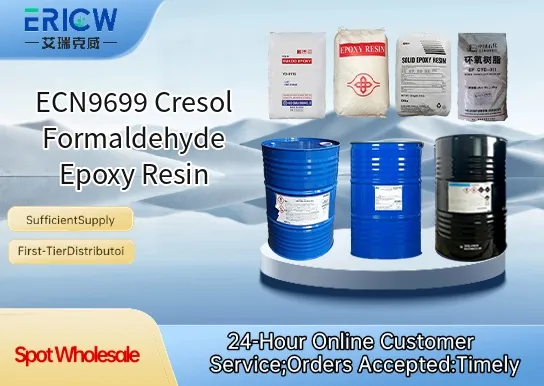
| Chemical Type | Cresol-formaldehyde novolac epoxy resin |
| Product Form | Pale yellow to amber solid flakes or granules |
| Appearance | Free-flowing, homogeneous solid at room temperature |
| Epoxy Equivalent Weight (EEW) | 210–230 g/eq |
| Softening Point | 85–95 °C |
| Chlorine Content | ≤ 900 ppm |
| Volatiles Content | ≤ 0.5 wt% |
| Storage Stability | Stable for ≥12 months at <25 °C in sealed containers |
Contact With Us:
E-mail: wangxingqiang@ericwchem.com
Have a Questions? Call Us:
Add:
Building A1, Jiete Industrial Park, Huangpu District, Guangzhou City, Guangdong Province, China