English
 Español
 tiếng việt
 русский
Excellent transparency and UV resistance for long-term outdoor durability.
High melt flow index enabling efficient extrusion and injection molding processing.
Good compatibility with polycarbonate (PC) and ABS for alloy formulations.
Low moisture absorption, minimizing dimensional change during service life.
Non-yellowing performance under thermal aging conditions up to 120°C.
Automotive interior trim components requiring high gloss and scratch resistance.
LED lighting lenses and diffusers demanding optical clarity and thermal stability.
Consumer electronics housings where aesthetics and processability are critical.
Medical device enclosures needing biocompatibility-supporting base polymer properties.
Architectural glazing sheets for signage and decorative panels.
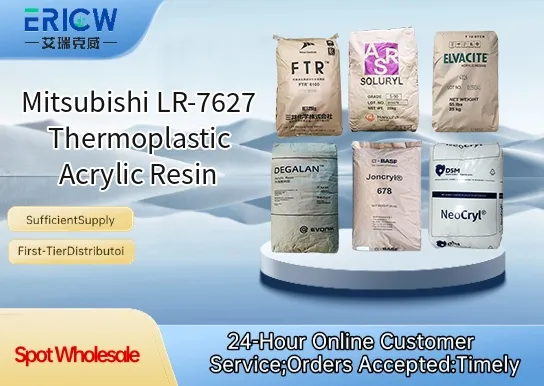
| Chemical Type | Thermoplastic acrylic copolymer |
| Product Form | Pellets |
| Appearance | Transparent, colorless granules |
| Melt Flow Index (230°C/3.8 kg) | 12–16 g/10 min |
| Density (23°C) | 1.18–1.20 g/cm³ |
| Glass Transition Temperature (Tg) | 104–107°C |
| Primary Applications | Optical parts, automotive interiors, durable consumer goods |
| Key Features | High clarity, thermal stability, easy processing, low haze |
Q1: What are the primary application areas for LR-7627?
A: LR-7627 is widely used in high-gloss, durable thermoplastic coatings for automotive trim, electronics housings, and consumer appliances. It is also employed as a rheology modifier and surface enhancer in solvent-based and high-solids acrylic systems where clarity, flow, and mar resistance are critical.
Q2: How does LR-7627 differ from conventional acrylic resins in terms of film formation and processing?
A: As a thermoplastic acrylic resin, LR-7627 forms films through physical cooling and solvent evaporation—without chemical crosslinking. This enables excellent re-dissolvability, compatibility with common organic solvents (e.g., toluene, xylene, esters), and suitability for processes like coil coating, spray application, and extrusion compounding where thermal reversibility is advantageous.
Q3: Is LR-7627 compatible with other polymer systems such as PVC, ABS, or polycarbonate?
A: Yes, LR-7627 demonstrates good compatibility with a range of engineering thermoplastics and thermosets, including PVC, ABS, and certain polycarbonate blends. It is often used to improve surface hardness, gloss retention, and solvent resistance in multi-component systems—though compatibility testing under actual formulation conditions is recommended.
Q4: What safety and handling considerations apply during industrial use?
A: LR-7627 is supplied as a solid resin or in solvent solution and should be handled in well-ventilated areas. Standard industrial hygiene practices apply—including avoidance of prolonged skin contact and inhalation of dust or solvent vapors. Refer to the Safety Data Sheet (SDS) for specific handling, storage, and first-aid guidance relevant to your formulation and process conditions.
Contact With Us:
E-mail: wangxingqiang@ericwchem.com
Have a Questions? Call Us:
Add:
Building A1, Jiete Industrial Park, Huangpu District, Guangzhou City, Guangdong Province, China