English
 Español
 tiếng việt
 русский
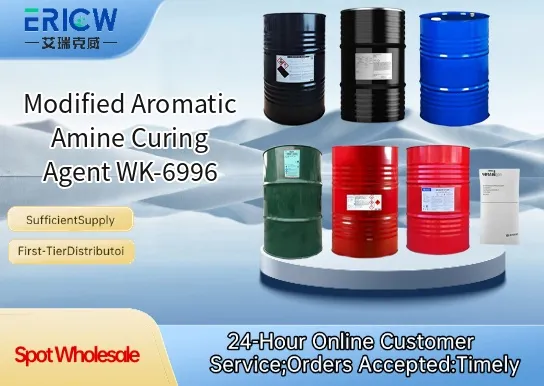
Enhanced reactivity at ambient temperature for rapid gel time and efficient production cycles.
Improved flexibility and impact resistance in cured epoxy systems without compromising thermal stability.
Low volatility and reduced amine odor, supporting safer handling and improved workplace air quality.
Excellent compatibility with standard bisphenol-A and novolac epoxy resins.
Hydrolytic stability under humid curing conditions, minimizing surface blush and interfacial defects.
High-performance structural adhesives for aerospace and automotive bonding.
Industrial flooring systems requiring chemical resistance and rapid return-to-service.
Electrical potting and encapsulation compounds for high-voltage insulation.
Composite matrix resins in wind turbine blade and marine laminate manufacturing.
Repair mortars and grouts for concrete infrastructure rehabilitation.
| Chemical Type | Modified aromatic amine |
| Product Form | Liquid |
| Appearance | Pale yellow to amber clear liquid |
| Primary Applications | Epoxy resin curing agent for structural composites and coatings |
| Key Features | Ambient-cure capability, low exotherm, high Tg retention |
| Benefits | Reduced VOC emissions, extended pot life vs. unmodified amines, improved adhesion to damp substrates |
| Density (25°C) | 1.08–1.12 g/cm³ |
| Viscosity (25°C) | 300–600 mPa·s |
Q1: What are the key advantages of WK-6996 compared to conventional aromatic amine curing agents?
A: WK-6996 offers improved compatibility with epoxy resins, reduced volatility, and enhanced handling safety due to its modified molecular structure. It typically delivers balanced pot life and cure speed without requiring elevated post-cure temperatures, supporting efficient processing in ambient or mild-heating applications.
Q2: Is WK-6996 suitable for use in coatings requiring high chemical resistance and low-temperature cure?
A: Yes — WK-6996 is specifically engineered to deliver robust crosslink density in cured films, contributing to excellent resistance against solvents, acids, and alkalis. Its reactivity profile enables effective cure at temperatures as low as 10–15°C, making it well-suited for field-applied or energy-sensitive coating systems.
Q3: How should WK-6996 be stored and handled to maintain stability and performance?
A: Store in tightly sealed containers under dry, cool conditions (below 30°C), protected from moisture and direct sunlight. Avoid prolonged exposure to air during handling, as humidity may affect reactivity over time. Standard industrial PPE — including nitrile gloves and eye protection — is recommended during dispensing and mixing.
Q4: Can WK-6996 be used in combination with other curing agents or accelerators?
A: WK-6996 is compatible with select phenolic accelerators and latent catalysts when co-formulated to fine-tune gel time or enhance low-temperature reactivity. However, compatibility testing is strongly advised before full-scale implementation, particularly when blending with aliphatic amines or imidazoles.
Q5: What types of epoxy resins does WK-6996 perform best with?
A: WK-6996 demonstrates broad compatibility with standard DGEBA-type liquid and solid epoxy resins, as well as novolac epoxies. Optimal performance is typically observed in medium-to-high molecular weight resins where balanced viscosity, film formation, and mechanical integrity are required.
Contact With Us:
E-mail: wangxingqiang@ericwchem.com
Have a Questions? Call Us:
Add:
Building A1, Jiete Industrial Park, Huangpu District, Guangzhou City, Guangdong Province, China