English
 Español
 tiếng việt
 русский
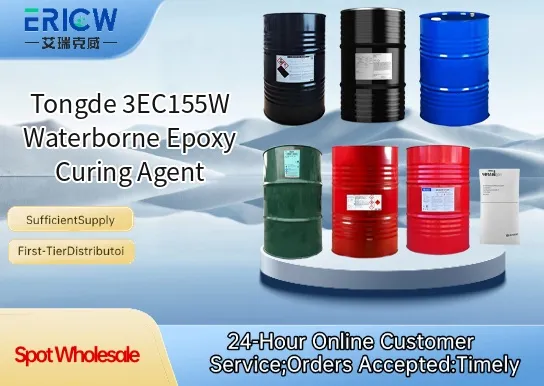
Low-VOC, water-based formulation compliant with stringent environmental regulations.
Excellent compatibility with common waterborne epoxy resins for stable emulsion systems.
Fast ambient-cure capability with good early hardness development at 20–25°C.
Superior chemical resistance after full cure, particularly to alkalis and mild solvents.
Low odor and non-hazardous handling profile—no ADR transport restrictions.
Waterborne epoxy floor coatings for industrial and commercial facilities.
Concrete repair mortars and protective topcoats in infrastructure projects.
Interior wall and ceiling coatings requiring low emissions and rapid return-to-service.
Anti-corrosive primers for steel substrates in mild exposure environments.
| Chemical Type | Polyamide-modified amine, water-dispersible |
| Product Form | Opaque white liquid |
| Appearance | Homogeneous, slightly viscous dispersion |
| pH (10% aqueous solution) | 8.2–8.8 |
| Solids Content (wt%) | 52–56% |
| Viscosity (mPa·s, 25°C, Brookfield RVT) | 1,200–2,000 |
| Minimum Film Formation Temperature (MFFT) | 12°C |
| Shelf Life (unopened, 5–30°C) | 12 months |
Q1: What types of waterborne epoxy resins is 3EC155W compatible with?
A: 3EC155W is specifically formulated for use with standard anionic or non-ionic waterborne epoxy dispersions, including bisphenol-A and bisphenol-F based systems. Compatibility should be verified experimentally in the target formulation due to variations in resin particle size, charge stability, and surfactant content.
Q2: How does 3EC155W contribute to film formation and final coating performance?
A: As a waterborne polyamine-based curing agent, 3EC155W enables ambient-temperature crosslinking with good coalescence behavior. It supports the development of coatings with balanced hardness, flexibility, and chemical resistance—particularly suited for industrial maintenance and protective applications where low VOC and reduced odor are priorities.
Q3: Can 3EC155W be used in food-contact or potable water applications?
A: 3EC155W is not pre-qualified for direct food-contact or potable water applications. Formulators seeking compliance for such end uses must conduct full regulatory evaluation—including migration testing and approval by relevant authorities—as suitability depends on the complete cured system, application method, and service conditions.
Q4: What is the recommended storage condition and shelf life?
A: Store in original sealed containers at temperatures between 5 °C and 30 °C, protected from frost and direct sunlight. Under these conditions, the typical unopened shelf life is 12 months from the date of manufacture. After opening, minimize exposure to air and moisture, and use within 3 months for optimal performance.
Contact With Us:
E-mail: wangxingqiang@ericwchem.com
Have a Questions? Call Us:
Add:
Building A1, Jiete Industrial Park, Huangpu District, Guangzhou City, Guangdong Province, China