English
 Español
 tiếng việt
 русский
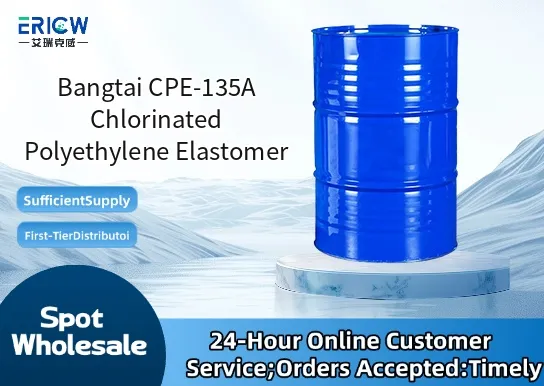
Excellent compatibility with PVC, rubber, and thermoplastic resins for seamless blending.
Outstanding weather resistance, UV stability, and long-term aging performance.
Good low-temperature flexibility down to –40 °C without significant embrittlement.
Flame-retardant properties enhanced by inherent chlorine content (approx. 35–38 wt%).
Superior oil, chemical, and abrasion resistance compared to standard polyethylene elastomers.
PVC impact modifiers for rigid profiles, pipes, and window frames.
Flexible cable sheathing and insulation compounds in wire & cable industry.
Automotive under-hood components requiring heat and fluid resistance.
Roofing membranes and geomembranes demanding durability and weatherproofing.
Industrial hoses, seals, and gaskets exposed to oils and environmental stressors.
| Chemical Type | Chlorinated Polyethylene (CPE) Elastomer |
| Product Form | Free-flowing granules |
| Appearance | White to off-white granular solid |
| Chlorine Content (wt%) | 35–38 |
| Moisture Content (max) | 0.5 wt% |
| Thermal Decomposition Onset (TGA, air) | ≥220 °C |
| Primary Applications | PVC modifier, rubber blend component, flame-retardant compound base |
| Key Features | High elasticity, processability in extrusion/injection molding, non-toxic formulation |
Q1: What is the primary functional role of Bangtai CPE-135A in polymer formulations?
A: Bangtai CPE-135A functions primarily as an impact modifier and compatibilizer—especially in rigid PVC, polypropylene, and ABS systems—enhancing toughness, low-temperature flexibility, and melt processability without significantly compromising tensile strength or thermal stability.
Q2: How does CPE-135A differ from standard CPE grades used in cable jacketing or roofing membranes?
A: Unlike general-purpose CPE grades optimized for weather resistance or flame retardancy synergy, CPE-135A is specifically engineered with a balanced chlorine content and controlled molecular structure to deliver superior elastomeric behavior and dispersion in thermoplastic blends—making it especially suitable for demanding extrusion and injection molding applications where dynamic mechanical performance is critical.
Q3: Is Bangtai CPE-135A compatible with peroxide-cured rubber systems?
A: While CPE-135A is not formulated for direct peroxide vulcanization like dedicated CPE rubbers, it can be effectively incorporated into peroxide-cured EPDM or NBR blends as a processing aid and phase modifier—improving filler dispersion and reducing compound viscosity during mixing and shaping.
Q4: What are the recommended drying and handling conditions prior to processing?
A: For optimal performance, CPE-135A should be dried at 60–70 °C for 2–4 hours under vacuum or low-humidity air flow to minimize moisture-induced surface defects. It is hygroscopic and should be stored in sealed containers away from direct sunlight and high ambient humidity.
Contact With Us:
E-mail: wangxingqiang@ericwchem.com
Have a Questions? Call Us:
Add:
Building A1, Jiete Industrial Park, Huangpu District, Guangzhou City, Guangdong Province, China