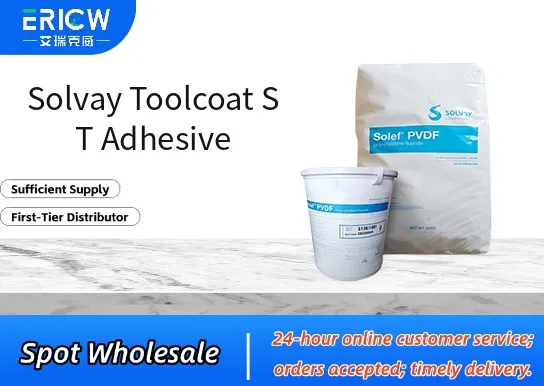
Features Of Solvay Toolcoat S T Adhesive
High-temperature resistance up to 200 °C for extended tool life in demanding thermal cycles.
Excellent chemical resistance against mold release agents, solvents, and epoxy-based composites.
Low-shrinkage formulation ensures dimensional stability and precise tool surface replication.
Fast room-temperature cure with optional heat-accelerated post-cure for rapid production turnaround.
Superior adhesion to carbon steel, Invar, aluminum, and composite tool substrates without priming.
Typical Applications Of Solvay Toolcoat S T Adhesive
Aerospace composite tooling for autoclave-cured CFRP structures.
Automotive thermoset molding tools used in SMC/BMC manufacturing.
Wind turbine blade tooling requiring long-term durability and surface fidelity.
Industrial vacuum bagging and out-of-autoclave (OOA) tooling systems.
Specifications Of Solvay Toolcoat S T Adhesive
| Chemical Type | Epoxy-modified phenolic resin system |
| Product Form | Two-component paste (Part A: resin/filler; Part B: hardener) |
| Appearance | Gray, homogeneous, non-sag paste |
| Mix Ratio (by weight) | 100 : 12 (A : B) |
| Cure Schedule (standard) | 24 h at 23 °C, or 4 h at 80 °C |
| Density (23 °C) | Approx. 1.85 g/cm³ |
| Shelf Life (unopened, 15–25 °C) | 12 months from date of manufacture |
| VOC Content | <50 g/L (compliant with EU Directive 2004/42/EC) |
Solvay Toolcoat S T Adhesive – Frequently Asked Questions (FAQ)
Q1: What is the primary function of Solvay Toolcoat S T Adhesive in composite manufacturing?
A: Solvay Toolcoat S T Adhesive is a high-performance release and bonding aid specifically engineered for tooling applications in thermoset composite processing. It enhances interfacial adhesion between tool surfaces and prepregs or resin-infused laminates while maintaining clean, reliable release after cure—enabling consistent part quality and extended tool life.
Q2: Is Solvay Toolcoat S T Adhesive compatible with common tooling materials such as aluminum, steel, and Invar?
A: Yes, it demonstrates excellent compatibility and adhesion across a broad range of metal tooling substrates—including aluminum, stainless steel, and Invar—without requiring specialized surface pretreatment beyond standard cleaning and degreasing protocols.
Q3: How is Solvay Toolcoat S T Adhesive typically applied, and what are the recommended curing conditions?
A: It is generally applied by spray, brush, or roller to clean, dry tool surfaces. A uniform thin film is preferred, followed by thermal curing at elevated temperatures—typically within the range used for standard composite tooling bake-outs (e.g., 120–180 °C), with full performance achieved after a post-cure cycle aligned with the production process.
Q4: Can Solvay Toolcoat S T Adhesive be reapplied after multiple demolding cycles?
A: Yes, it supports re-coating without complete removal—provided the existing layer remains intact and contamination-free. Light abrasion or solvent wipe may be used prior to reapplication if surface integrity or release performance shows signs of degradation.
 English
 Español
 tiếng việt
 русский