English
 Español
 tiếng việt
 русский
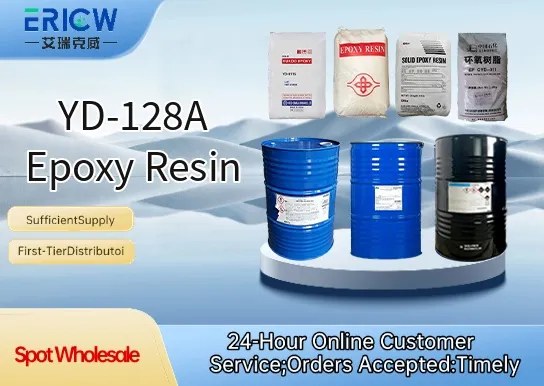
High purity bisphenol-A based liquid epoxy resin with consistent molecular weight distribution.
Excellent compatibility with common amine, anhydride, and phenolic curing agents.
Low viscosity (11,000–13,000 cP at 25°C) enabling easy processing and improved filler dispersion.
Superior electrical insulation properties and low dielectric loss at elevated frequencies.
Good thermal stability with glass transition temperature (Tg) of cured system up to 125°C.
Electrical encapsulation and potting compounds for transformers, reactors, and sensors.
High-voltage insulating coatings and busbar protective layers.
Structural adhesives in aerospace and automotive composite bonding.
Base resin for filament-wound pipes and pressure vessels requiring chemical resistance.
Matrix resin in printed circuit board (PCB) prepregs and laminates.
| Chemical Type | Bisphenol-A diglycidyl ether (DGEBA) |
| Product Form | Clear, low-viscosity amber liquid |
| Appearance | Transparent to slightly yellow, homogeneous liquid |
| Epoxy Equivalent Weight (EEW) | 187–193 g/eq |
| Viscosity (25°C) | 11,000–13,000 cP |
| Chlorine Content | ≤ 800 ppm |
| Hydrolyzable Chloride | ≤ 150 ppm |
| Softening Point | Not applicable (liquid at room temperature) |
Q1: What is the typical molecular weight range of YD-128A Epoxy Resin?
A: YD-128A is a bisphenol-A based liquid epoxy resin with a relatively low molecular weight, placing it in the standard industrial grade range suitable for general-purpose reactive dilution and crosslinking applications.
Q2: Is YD-128A compatible with common amine and anhydride curing agents?
A: Yes, YD-128A demonstrates broad compatibility with aliphatic and cycloaliphatic amines, as well as carboxylic anhydrides, enabling flexible formulation design for coatings, adhesives, and electrical encapsulation systems.
Q3: How does YD-128A perform in terms of moisture resistance and electrical insulation?
A: As a standard-grade bisphenol-A epoxy, YD-128A delivers good moisture barrier properties and high dielectric strength after proper curing, making it well-suited for printed circuit board laminates and insulating varnishes.
Q4: Can YD-128A be used in food-contact or medical device applications?
A: YD-128A is not pre-qualified for direct food-contact or implantable medical device use. Formulators must conduct full regulatory evaluation—including migration testing and biocompatibility assessment—based on final cured system composition and intended application.
Contact With Us:
E-mail: wangxingqiang@ericwchem.com
Have a Questions? Call Us:
Add:
Building A1, Jiete Industrial Park, Huangpu District, Guangzhou City, Guangdong Province, China