English
 Español
 tiếng việt
 русский
Excellent thermal stability up to 250 °C in inert atmospheres.
Superior resistance to UV radiation and oxidative degradation.
Low volatility with negligible evaporation loss under standard storage conditions.
Good compatibility with organic polymers, resins, and silicone elastomers.
Hydrophobic surface properties enabling effective water repellency in coatings and sealants.
High-temperature lubricants for precision instruments and aerospace components.
Release agents in thermoset molding of composites and engineered plastics.
Base fluid in specialty heat-transfer fluids for semiconductor manufacturing equipment.
Surface modifier in optical-grade silicone gels and encapsulants.
Additive in high-performance greases requiring extended service life at elevated temperatures.
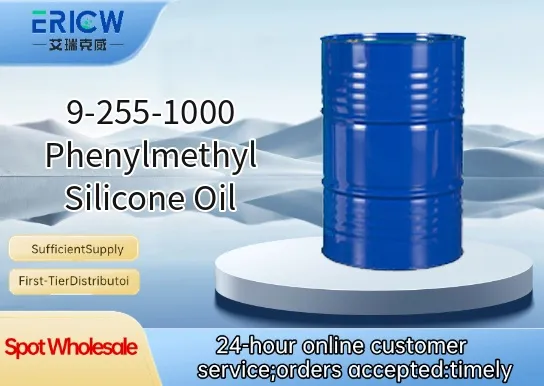
| Chemical Type | Phenylmethyl polysiloxane |
| Product Form | Clear, colorless to pale yellow liquid |
| Appearance | Homogeneous, transparent, free from sediment or haze |
| Viscosity (25 °C, cSt) | 1000 ± 100 |
| Density (25 °C, g/cm³) | 1.03–1.06 |
| Refractive Index (25 °C) | 1.500–1.515 |
| Flash Point (COC, °C) | ≥ 300 |
| Key Features | Thermally stable, UV-resistant, low volatility, hydrophobic |
Q1: What distinguishes 9-255-1000 from standard dimethyl silicone oils?
A: 9-255-1000 features phenyl groups substituted along the siloxane backbone, which significantly enhances thermal stability, UV resistance, and compatibility with aromatic solvents and high-performance polymers—unlike conventional dimethyl silicone oils.
Q2: In which industrial applications is this phenylmethyl silicone oil most commonly used?
A: It is widely employed as a release agent in high-temperature molding, a rheology modifier in specialty coatings and inks, a damping fluid in precision instruments, and a component in high-stability lubricants and dielectric fluids where oxidative or thermal degradation resistance is critical.
Q3: How does viscosity behavior change with temperature for this grade?
A: Like other phenylmethyl silicones, 9-255-1000 exhibits low viscosity-temperature sensitivity—its viscosity remains relatively stable across a broad operating range, supporting consistent performance in both elevated and sub-ambient conditions.
Q4: Is 9-255-1000 compatible with common elastomers and thermoplastics?
A: Yes—it demonstrates good compatibility with silicone rubbers, fluoropolymers, polyimides, and many engineering thermoplastics, though compatibility testing under actual processing conditions is recommended due to formulation-specific interactions.
Contact With Us:
E-mail: wangxingqiang@ericwchem.com
Have a Questions? Call Us:
Add:
Building A1, Jiete Industrial Park, Huangpu District, Guangzhou City, Guangdong Province, China