Two-component, room-temperature curing silicone elastomer system offering excellent flexibility and long-term reliability.
Outstanding resistance to thermal cycling, moisture, and environmental aging—maintains performance across -55 °C to +180 °C.
Low modulus and high elongation (>200%) enable stress relief for sensitive electronic components during thermal expansion.
UL 94 V-0 rated for flame retardancy and compliant with RoHS and REACH regulatory requirements.
Excellent electrical insulation properties with stable dielectric strength and volume resistivity over time.
Encapsulation of power electronics, including IGBT modules and inverters in electric vehicles and renewable energy systems.
Potting of sensors and control units exposed to harsh automotive under-hood environments.
Protection of LED drivers and lighting assemblies requiring thermal stability and optical clarity retention.
Sealing and encapsulation of industrial automation controllers subjected to vibration and wide temperature swings.
Insulation of high-voltage battery management systems (BMS) in energy storage applications.
| Chemical Type | Platinum-cured addition-cure silicone elastomer |
| Product Form | Two-component liquid (Part A: base; Part B: catalyst) |
| Appearance | Translucent, low-viscosity liquid (Part A); colorless to pale yellow liquid (Part B) |
| Mix Ratio (by weight) | 10:1 (A:B) |
| Cure Time (RT, 23 °C) | 24 hours to handling strength; 72 hours for full cure |
| Hardness (Shore A, cured) | 25–30 |
| Elongation at Break | ≥220% |
| Volume Resistivity (23 °C) | ≥1.0 × 10¹⁵ Ω·cm |
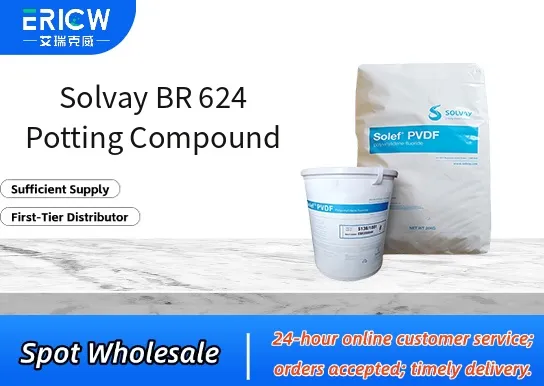
Q1: What is the primary function of Solvay BR 624 in potting applications?
A: Solvay BR 624 is a reactive liquid polymer designed to serve as a base resin or co-resin in thermosetting potting compounds, providing excellent electrical insulation, thermal stability, and mechanical integrity after cure.
Q2: Is Solvay BR 624 compatible with common curing agents used in epoxy-based potting systems?
A: Yes, Solvay BR 624 is formulated to be compatible with standard amine- and anhydride-type hardeners, enabling flexible formulation development for tailored gel time, cure profile, and final properties.
Q3: How does Solvay BR 624 contribute to moisture resistance in encapsulated electronic components?
A: Due to its low polarity and hydrophobic molecular structure, Solvay BR 624 helps reduce water absorption in cured potting matrices, thereby enhancing long-term reliability of electronics exposed to humid or condensing environments.
Q4: Can Solvay BR 624 be blended with fillers and other resins without compromising processability?
A: Yes — it exhibits good compatibility with silica, alumina, and other common functional fillers, and can be readily mixed with epoxy, phenolic, or silicone resins to adjust viscosity, thermal conductivity, or coefficient of thermal expansion.
Contact With Us:
E-mail: wangxingqiang@ericwchem.com
Have a Questions? Call Us:
Add:
Building A1, Jiete Industrial Park, Huangpu District, Guangzhou City, Guangdong Province, China
 English
 Español
 tiếng việt
 русский