English
 Español
 tiếng việt
 русский
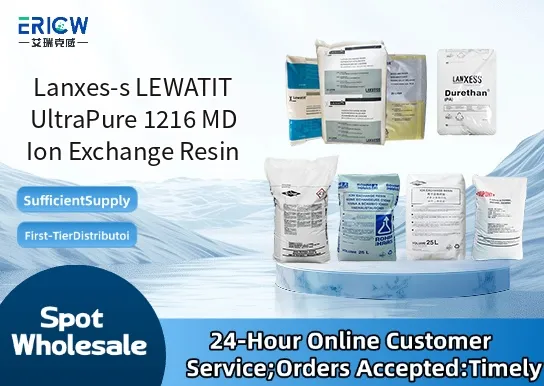
Ultra-low extractables profile specifically engineered for ultra-high-purity water production in pharmaceutical and biotech manufacturing.
Highly uniform spherical beads with narrow particle size distribution (0.45–0.63 mm) ensuring consistent hydraulic performance and minimal pressure drop.
Exceptional chemical stability in both acidic and alkaline regenerant solutions, enabling long service life under cyclic operation.
Low total organic carbon (TOC) release and minimal leachable metals—certified to meet USP <848> and EP 2.2.59 requirements for purified water systems.
Optimized for mixed-bed configurations with complementary cation resin LEWATIT UltraPure 1217 MD, delivering resistivity >18.2 MΩ·cm at 25°C.
Final polishing step in pharmaceutical-grade purified water (PW) and water for injection (WFI) generation systems.
Critical deionization in biopharmaceutical upstream and downstream processing utilities.
Ultrapure water production for semiconductor wafer cleaning and photolithography rinse applications.
High-reliability mixed-bed polishing in clinical laboratory and diagnostic instrument feedwater systems.
Regulatory-compliant water treatment for FDA- and EMA-inspected GMP manufacturing facilities.
| Chemical Type | Strong base anion exchange resin, Type I quaternary ammonium functional group |
| Product Form | Moist, spherical gel-type beads |
| Appearance | Off-white to light yellow, translucent beads |
| Particle Size Range | 0.45–0.63 mm (95% retained on 0.45 mm sieve) |
| Uniformity Coefficient | ≤1.6 |
| Moisture Content | 47–52% (as shipped) |
| Functional Capacity (Cl⁻ form) | ≥1.2 eq/L (dry basis) |
| Maximum Operating Temperature | 60°C |
Q1: What is the primary application of Lanxes-s LEWATIT UltraPure 1216 MD?
A: This resin is specifically engineered for high-purity water polishing in ultra-sensitive applications such as pharmaceutical-grade water systems, biopharmaceutical process streams, and semiconductor rinse water treatment—where removal of trace ionic contaminants and low leachables are critical.
Q2: How does Lanxes-s LEWATIT UltraPure 1216 MD differ from standard Lewatit® 1216 resins?
A: UltraPure 1216 MD features an enhanced manufacturing protocol—including additional post-synthesis washing and stringent quality control—to minimize residual monomers, oligomers, and extractables. It also undergoes rigorous testing for total organic carbon (TOC) release and conductivity stability under low-flow, high-resistivity conditions.
Q3: Is this resin suitable for use in sanitary or single-use systems?
A: Yes—it is compatible with sanitary design requirements and commonly installed in hygienic cartridge housings or stainless-steel vessels with SIP/CIP protocols. Its highly crosslinked matrix ensures dimensional stability and minimal fines generation during repeated thermal or chemical cleaning cycles.
Q4: What regeneration protocol is recommended for optimal performance and longevity?
A: Standard sodium chloride regeneration is effective for cation exchange mode; however, for ultra-high purity service, a two-step regeneration—first with high-purity NaCl followed by thorough deionized water rinsing—is strongly advised to suppress ionic carryover and maintain resistivity above 18.0 MΩ·cm.
Contact With Us:
E-mail: wangxingqiang@ericwchem.com
Have a Questions? Call Us:
Add:
Building A1, Jiete Industrial Park, Huangpu District, Guangzhou City, Guangdong Province, China