English
 Español
 tiếng việt
 русский
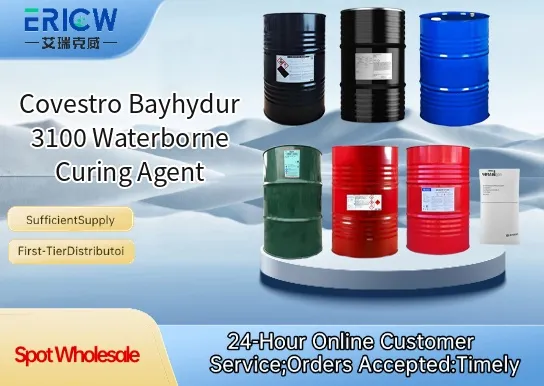
Waterborne aliphatic polyisocyanate crosslinker with low VOC and zero APEO content.
Excellent compatibility with acrylic, polyester, and hybrid waterborne resins.
Fast ambient-cure performance with good pot life stability in aqueous dispersions.
Delivers outstanding gloss retention, weather resistance, and chemical resistance in final coatings.
Enables high-film-build coatings without viscosity build-up or phase separation.
Automotive OEM and refinish clearcoats and basecoats.
Industrial maintenance coatings for metal substrates.
Wood coatings requiring low-odor, high-clarity finishes.
Plastic coatings for interior automotive parts and consumer electronics.
| Chemical Type | Aliphatic polyisocyanate (HDI-based) |
| Product Form | Aqueous dispersion |
| Appearance | Clear to slightly hazy, colorless to pale yellow liquid |
| NCO Content (wt%) | 7.5 – 8.5% |
| pH (25 °C) | 7.0 – 8.5 |
| Viscosity (mPa·s, 25 °C) | 200 – 600 |
| Solids Content (wt%) | 35 – 40% |
| Storage Stability | ≥ 6 months at 5–30 °C (unopened) |
Q1: What is Bayhydur 3100 and how does it differ from solvent-borne polyisocyanate curing agents?
A: Bayhydur 3100 is a water-dispersible aliphatic polyisocyanate specifically designed for high-performance waterborne two-component polyurethane systems. Unlike traditional solvent-borne curing agents, it enables low-VOC formulations without compromising film hardness, chemical resistance, or gloss retention — while offering improved handling safety and reduced environmental impact.
Q2: Which types of resins is Bayhydur 3100 compatible with in waterborne systems?
A: Bayhydur 3100 is primarily formulated to crosslink waterborne polyacrylates, polyurethane dispersions (PUDs), and hybrid acrylic-PUD systems. Compatibility should always be verified experimentally, as performance depends on resin functionality, pH, particle size, and stabilization chemistry.
Q3: How should Bayhydur 3100 be incorporated into a waterborne coating formulation?
A: It is typically added to the aqueous resin phase under gentle agitation at ambient temperature, avoiding high-shear mixing that may destabilize the dispersion. Pre-dilution with deionized water or compatible co-solvents is recommended before addition. The pot life is generally sufficient for industrial processing but decreases with increasing temperature and humidity.
Q4: Does Bayhydur 3100 require catalysts or co-reactants for efficient curing?
A: While Bayhydur 3100 cures effectively without catalysts under ambient or mild thermal conditions, tertiary amine catalysts (e.g., DABCO variants) or latent metal catalysts may be used to accelerate cure speed or improve low-temperature performance — provided compatibility and storage stability are confirmed.
Contact With Us:
E-mail: wangxingqiang@ericwchem.com
Have a Questions? Call Us:
Add:
Building A1, Jiete Industrial Park, Huangpu District, Guangzhou City, Guangdong Province, China