English
 Español
 tiếng việt
 русский
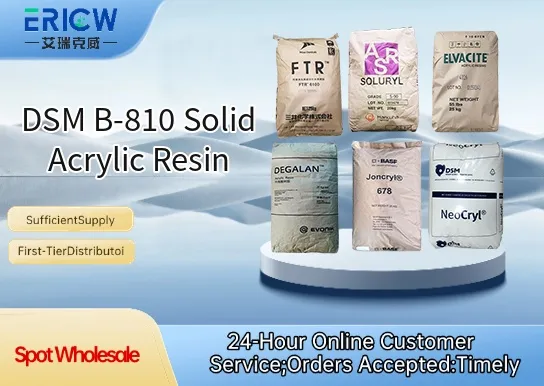
High molecular weight solid acrylic resin offering excellent film-forming capability and hardness.
Outstanding UV resistance and long-term color stability for outdoor applications.
Good solubility in common organic solvents including toluene, xylene, and ester-based systems.
Low volatile organic compound (VOC) contribution when formulated into compliant coatings.
Thermally stable with consistent melt viscosity for reliable processing in extrusion and compounding.
Automotive clearcoats and OEM topcoats requiring high gloss and durability.
Industrial maintenance coatings for metal and plastic substrates.
High-performance coil coatings with excellent flexibility and corrosion resistance.
Architectural coatings for façade and roofing systems exposed to harsh weather.
Plastic coatings and overprint varnishes for rigid packaging and consumer electronics.
| Chemical Type | Thermoplastic solid acrylic copolymer |
| Product Form | Free-flowing granular solid |
| Appearance | White to off-white granules |
| Glass Transition Temperature (Tg) | ~105–110 °C (DSC, 10 °C/min) |
| Acid Number | < 5 mg KOH/g |
| Residual Monomer Content | < 0.1 wt% |
| Moisture Content | < 0.5 wt% |
| Primary Applications | High-gloss automotive & industrial coatings, plastic finishing, protective topcoats |
Q1: What is the primary function of DSM B-810 in coating and ink formulations?
A: DSM B-810 functions as a high-performance film-forming binder and rheology modifier, enhancing gloss, hardness, and mar resistance while supporting excellent pigment dispersion stability in solvent-based and high-solids systems.
Q2: Is DSM B-810 suitable for food-contact coatings?
A: DSM B-810 is designed for industrial and decorative applications where regulatory compliance for indirect food contact may be required; however, final compliance depends on full formulation assessment and applicable regional regulations—users must conduct appropriate testing and verification.
Q3: How does DSM B-810 compare to conventional acrylic resins in terms of solubility and viscosity behavior?
A: DSM B-810 offers improved solubility in common organic solvents (e.g., esters, ketones, aromatic hydrocarbons) and delivers lower solution viscosity at equivalent solids content, facilitating higher formulation solids and improved application efficiency.
Q4: Can DSM B-810 be used in combination with other resin types, such as alkyds or polyurethanes?
A: Yes, DSM B-810 demonstrates good compatibility with many crosslinkable resins including melamine formaldehydes, polyisocyanates, and certain alkyd systems—compatibility should be confirmed through small-scale blending trials under intended processing conditions.
Contact With Us:
E-mail: wangxingqiang@ericwchem.com
Have a Questions? Call Us:
Add:
Building A1, Jiete Industrial Park, Huangpu District, Guangzhou City, Guangdong Province, China