English
 Español
 tiếng việt
 русский
Highly selective palladium-based heterogeneous catalyst for efficient C–C coupling reactions.
Thermally stable up to 180 °C, enabling robust performance under demanding process conditions.
Low leaching profile (<0.1 ppm Pd in filtrate), ensuring product purity and catalyst recyclability.
Engineered with controlled particle size distribution (D50 ≈ 25 µm) for optimal reactor flow and filtration.
Pre-activated formulation — ready for use without pre-reduction or conditioning steps.
Pharmaceutical intermediate synthesis via Suzuki and Heck cross-coupling reactions.
Agrochemical active ingredient manufacturing requiring high chemo- and regioselectivity.
Electronic materials production, including conjugated polymers for OLED and semiconductor applications.
Fine chemical synthesis of complex aromatic and heteroaromatic building blocks.
Sustainable process intensification in continuous-flow reactors for green chemistry initiatives.
| Chemical Type | Palladium on high-surface-area carbon support |
| Product Form | Free-flowing black powder |
| Appearance | Uniform dark gray to black granular solid |
| Palladium Content | 5.0 ± 0.3 wt% |
| BET Surface Area | 850–950 m²/g |
| Moisture Content | ≤ 0.5 wt% |
| Particle Size (D50) | 22–28 µm |
| Storage Condition | Under inert atmosphere at 15–25 °C |
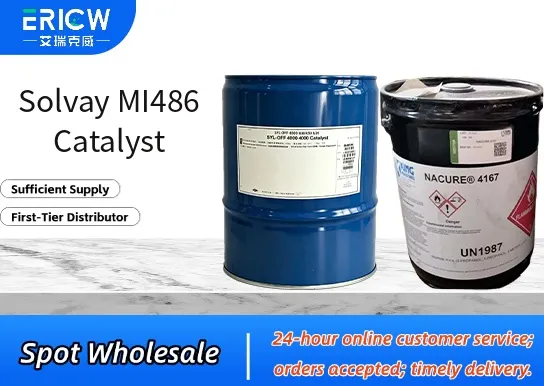
Q1: What is the primary function of Solvay MI486 Catalyst in silicone elastomer systems?
A: Solvay MI486 Catalyst is a platinum-based hydrosilylation catalyst designed to promote efficient crosslinking between Si–H and vinyl-functional siloxanes, enabling rapid and controlled cure of addition-cure liquid silicone rubber (LSR) and high-consistency rubber (HCR) formulations.
Q2: Is Solvay MI486 Catalyst compatible with common silicone fillers and inhibitors?
A: Yes — MI486 demonstrates good compatibility with standard reinforcing fillers such as fumed silica and precipitated silica, and can be effectively used with common hydrosilylation inhibitors (e.g., alkynols or enynes) to provide controlled pot life and reliable heat-activated cure profiles.
Q3: How should Solvay MI486 Catalyst be handled and stored to maintain activity?
A: Store under inert atmosphere (e.g., nitrogen or argon), protected from moisture, light, and elevated temperatures. Keep tightly sealed in original packaging at room temperature; avoid prolonged exposure to air or contact with heavy metals, sulfur-, phosphorus-, or nitrogen-containing compounds that may cause poisoning.
Q4: What types of processing methods is Solvay MI486 Catalyst suitable for?
A: MI486 is widely used in high-speed injection molding of LSR, as well as compression and transfer molding of HCR. Its consistent reactivity profile supports reproducible cycle times and excellent part-to-part uniformity across industrial-scale production.
Contact With Us:
E-mail: wangxingqiang@ericwchem.com
Have a Questions? Call Us:
Add:
Building A1, Jiete Industrial Park, Huangpu District, Guangzhou City, Guangdong Province, China