English
 Español
 tiếng việt
 русский
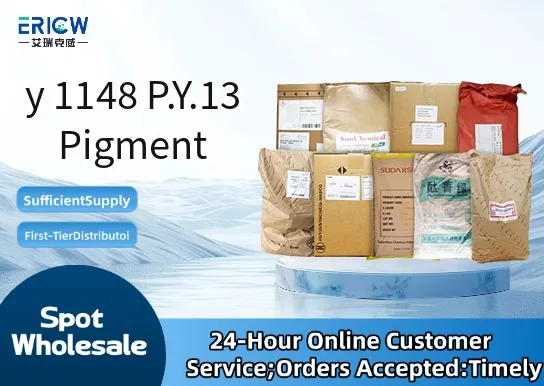
High chromatic strength with excellent color purity in yellow shade.
Good thermal stability up to 200°C, suitable for medium-temperature processing.
Excellent lightfastness (ASTM Level 7–8) under indoor and semi-outdoor exposure.
Low volatility and negligible migration in polymer matrices.
Compatible with major resin systems including PVC, ABS, PS, and polyolefins.
Coloration of rigid and flexible PVC profiles and sheets.
Automotive interior plastics requiring non-blooming yellow hues.
Masterbatch production for injection-molded consumer goods.
Industrial coatings for metal and plastic substrates.
Food-contact-compliant packaging films (subject to local regulatory approval).
| Chemical Type | Azo pigment (Pigment Yellow 13) |
| Product Form | Fine powder |
| Appearance | Yellow to greenish-yellow free-flowing powder |
| Primary Applications | Polymer coloration, industrial coatings, masterbatches |
| Key Features | Good dispersibility, low dust generation, high tinctorial strength |
| Benefits | Consistent batch-to-batch performance, low dosage requirement |
| Heat Stability | ≤ 200°C (20 min, air) |
| Lightfastness (ISO 105-B02) | Level 7–8 |
Q1: What is the primary chemical class and typical application field for y 1148 P.Y.13 Pigment?
A: y 1148 P.Y.13 is an organic monoazo pigment, widely used for coloration in industrial coatings, plastics, and printing inks where good lightfastness and clean yellow hue are required.
Q2: Is y 1148 P.Y.13 suitable for food-contact or pharmaceutical applications?
A: This pigment is not certified for direct food-contact or pharmaceutical use. It is intended for general industrial applications; regulatory compliance for specific end uses must be verified separately by the formulator.
Q3: How does y 1148 P.Y.13 perform in heat-sensitive polymer systems like polyolefins?
A: It demonstrates acceptable thermal stability for standard processing conditions in polyolefins and ABS, though prolonged exposure above 220°C may lead to slight hue shift; stabilization additives are recommended for high-temperature extrusion.
Q4: What dispersion methods are recommended to achieve optimal color strength and consistency?
A: High-shear dispersing equipment—such as three-roll mills or high-speed dispersers—is recommended. Pre-wetting with compatible solvents or resins improves deagglomeration, especially in solvent-based systems.
Contact With Us:
E-mail: wangxingqiang@ericwchem.com
Have a Questions? Call Us:
Add:
Building A1, Jiete Industrial Park, Huangpu District, Guangzhou City, Guangdong Province, China