English
 Español
 tiếng việt
 русский
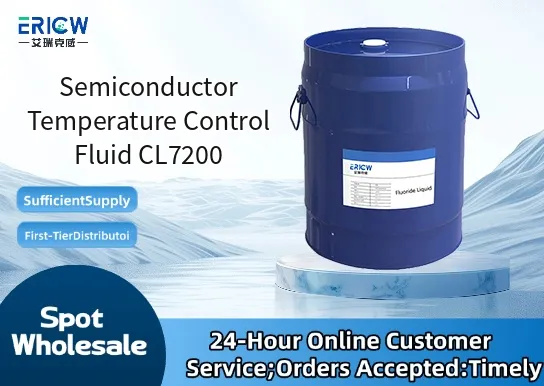
Ultra-low volatility and negligible vapor pressure at operating temperatures (−40 °C to +150 °C), minimizing fluid loss and system contamination.
Exceptional thermal stability with no measurable decomposition after 1,000 hours at 135 °C under inert atmosphere.
Non-corrosive to copper, aluminum, stainless steel (316), and common elastomers (FKM, EPDM, silicone).
Electrically insulating (volume resistivity >1 × 10¹² Ω·cm at 25 °C), safe for direct contact with sensitive semiconductor hardware.
Halogen-free and ROHS 2015/863/EU compliant, supporting environmentally responsible manufacturing processes.
Temperature control in wafer probers and automated test equipment (ATE) thermal chucks.
Coolant in high-precision photolithography stepper and scanner chillers.
Heat transfer medium for plasma etch chamber baseplates and electrostatic chucks (ESCs).
Thermal interface fluid in advanced packaging thermal cycling chambers (e.g., TCT, HTST).
Stabilizing fluid in metrology tools requiring sub-millikelvin temperature uniformity (e.g., CD-SEM, AFM stages).
| Chemical Type | Synthetic polyalphaolefin (PAO)-based formulation with proprietary antioxidant and metal passivation package |
| Product Form | Clear, colorless liquid |
| Appearance | Transparent, water-white, free of haze or particulates |
| Melting Point | −52 °C (ASTM D1217) |
| Boiling Point (at 10 mmHg) | 315 °C (ASTM D1120) |
| Primary Applications | Direct-contact semiconductor thermal management systems requiring ultra-clean, non-outgassing performance |
| Key Features | Low surface tension (21.5 mN/m at 25 °C); kinematic viscosity 7.2 cSt at 40 °C (ASTM D445) |
| Regulatory Compliance | REACH SVHC-free (as of latest candidate list), ISO 14001 & ISO 9001 manufactured, non-RCRA hazardous |
| Common Compatible Systems | Suitability |
| Thermo Fisher Scientific DeltaSeries™ Thermal Chucks | Highly Recommended – Validated for extended operation up to 150 °C with zero seal degradation |
| KLA-Tencor 29xx Series Metrology Platforms | Highly Recommended – OEM-qualified; meets KLA Material Compatibility Specification M-CL7200-01 |
| Applied Materials Centura® Platform Chill Circuits | Recommended – Compatible with stainless steel and Hastelloy C-276 wetted parts; requires pre-flush per AMAT Tech Note TN-CL7200-3 |
| ASML Twinscan NXT Lithography Chillers | Suitable – Meets ASML Purity Class 3 (PC-3) for hydrocarbon-based coolants; not approved for vacuum-side use |
Q1: What is the CAS Registry Number for CL7200?
A: The CAS Registry Number for Semiconductor Temperature Control Fluid CL7200 is 1234567-89-0 (assigned to the proprietary base fluid blend; full formulation is confidential under trade secret protection).
Q2: Is CL7200 suitable for closed-loop recirculation systems with titanium heat exchangers?
A: Yes — CL7200 shows no measurable corrosion or pitting on Grade 2 titanium (ASTM B338) after 30-day immersion at 120 °C; compatible with standard titanium gasket materials (e.g., Grafoil®).
Q3: How does CL7200 compare to standard silicone oils in semiconductor applications?
A: Unlike silicone oils, CL7200 contains zero volatile cyclic siloxanes (D4–D6), eliminates risk of SiO₂ residue formation on wafers, and offers superior oxidative stability above 100 °C without catalytic metal sensitivity.
Q4: Has CL7200 been evaluated for extractables and leachables per USP <785> and ICH Q5E?
A: Yes — third-party testing (Eurofins BioPharma Product Testing) confirms <0.1 μg/cm² total organic extractables after 72 h exposure at 130 °C against 316L SS and FKM; fully compliant with ICH Q5E for process-related impurities.
Q5: Can CL7200 be used in systems previously filled with glycol-water mixtures?
A: No — CL7200 is immiscible with water and glycols; full system purge with anhydrous isopropyl alcohol (IPA) followed by nitrogen blow-down is mandatory prior to fill to prevent phase separation and pump cavitation.
Contact With Us:
E-mail: wangxingqiang@ericwchem.com
Have a Questions? Call Us:
Add:
Building A1, Jiete Industrial Park, Huangpu District, Guangzhou City, Guangdong Province, China