English
 Español
 tiếng việt
 русский
Excellent soft-touch feel with balanced elasticity and recovery performance.
Good processability on standard injection molding and extrusion equipment.
Enhanced thermal stability for consistent output during high-speed production.
Low extractables and compliant with FDA 21 CFR §177.2600 for food-contact applications.
Compatible with polypropylene (PP) and polyethylene (PE) substrates for overmolding.
Soft-grip handles for power tools and household appliances.
Seals and gaskets in automotive interior components.
Food-grade kitchenware accessories including spatulas and jar openers.
Medical device grips requiring biocompatibility and sterilization resistance.
Consumer electronics casings and protective sleeves.
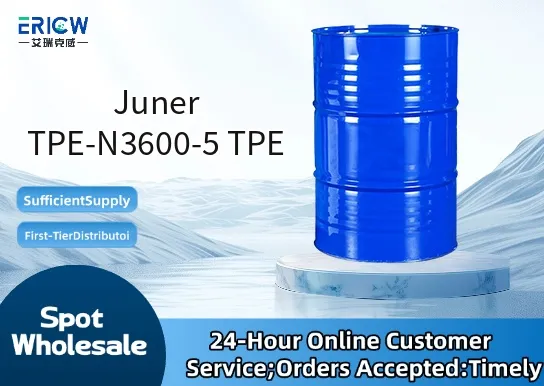
| Chemical Type | Thermoplastic Elastomer (TPE), SEBS-based |
| Product Form | Pellets |
| Appearance | Off-white to light beige, free-flowing granules |
| Primary Applications | Overmolding, soft-touch components, food-contact parts |
| Key Features | PP/PE compatibility, low odor, good UV resistance |
| Benefits | Reduced cycle time, no vulcanization required, recyclable |
| Processing Temperature Range | 180–220 °C (injection molding) |
| Storage Conditions | Keep in dry, ventilated area at <25 °C; use within 12 months of manufacture |
Q1: What is the primary function of Juner TPE-N3600-5 in thermoplastic elastomer formulations?
A: Juner TPE-N3600-5 is a functional modifier designed to enhance melt processability and improve surface finish in TPE compounds, particularly in styrenic (TPE-S) and thermoplastic polyolefin (TPO)-based systems.
Q2: Is Juner TPE-N3600-5 compatible with common TPE base polymers such as SEBS or PP/EPDM blends?
A: Yes, it demonstrates good compatibility with a broad range of TPE matrices including SEBS, SBS, and PP/EPDM-based TPOs, supporting uniform dispersion without phase separation under standard compounding conditions.
Q3: How should Juner TPE-N3600-5 be incorporated into a TPE compound?
A: It is typically added during the masterbatch or final compounding stage using conventional twin-screw extrusion. Pre-drying is not required, and it disperses effectively at standard processing temperatures for TPEs.
Q4: Does Juner TPE-N3600-5 affect the mechanical properties of the final TPE product?
A: When used within recommended dosage ranges, it maintains key mechanical performance attributes such as tensile strength and elongation at break, while often contributing to improved flow and reduced die swell.
Contact With Us:
E-mail: wangxingqiang@ericwchem.com
Have a Questions? Call Us:
Add:
Building A1, Jiete Industrial Park, Huangpu District, Guangzhou City, Guangdong Province, China