English
 Español
 tiếng việt
 русский
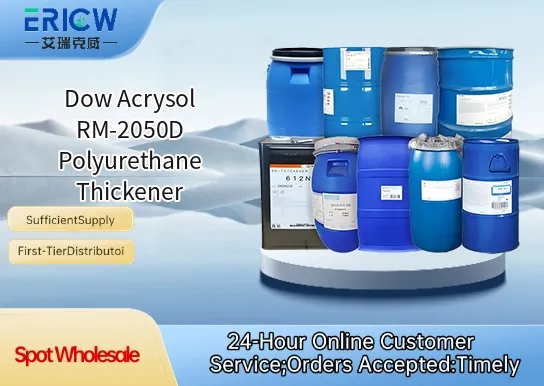
Non-ionic, hydrophobically modified polyurethane (HEUR) rheology modifier.
Delivers excellent mid-shear viscosity building and sag resistance in waterborne systems.
Provides outstanding compatibility with surfactants and co-thickeners, including cellulosics and associative thickeners.
Enables low foaming and good spatter resistance during application.
Offers robust viscosity stability across a broad pH range (pH 4–10).
Architectural interior and exterior latex paints.
Industrial maintenance coatings and OEM finishes.
Waterborne wood stains and clear finishes.
Textile printing pastes and functional coatings.
Adhesives and sealants requiring controlled flow and leveling.
| Chemical Type | Hydrophobically Modified Polyurethane (HEUR) |
| Product Form | Liquid dispersion |
| Appearance | Opaque white to off-white viscous liquid |
| pH (1% aqueous solution) | 6.0 – 8.0 |
| Active Content (wt%) | 25 – 27% |
| Density (25°C) | 1.02 – 1.06 g/cm³ |
| Solids Content (wt%) | 25 – 27% |
| Primary Applications | Waterborne architectural and industrial coatings |
Q1: What is the primary function of Acrysol RM-2050D in waterborne coatings?
A: Acrysol RM-2050D is a non-ionic, hydrophobically modified polyurethane (HEUR) rheology modifier designed to provide efficient mid-shear viscosity control, excellent flow and leveling, and robust sag resistance in architectural and industrial waterborne coatings.
Q2: How does RM-2050D differ from associative acrylic thickeners like Acrysol ASE or HASE types?
A: Unlike associative acrylic thickeners, RM-2050D relies on polyurethane-based hydrophobic associations that are less sensitive to pH, electrolytes, and surfactants—offering more consistent thickening performance in complex, high-solids, or low-VOC formulations where ionic thickeners may destabilize.
Q3: Can RM-2050D be used in combination with other thickeners?
A: Yes—RM-2050D is commonly blended with cellulosic or other HEUR thickeners to balance low-, mid-, and high-shear rheology. Synergistic combinations should be evaluated empirically, as compatibility depends on formulation composition, especially surfactant type and concentration.
Q4: What is the recommended addition method for optimal performance?
A: RM-2050D is typically added during the let-down stage, after pigments and most surfactants are dispersed. It should be diluted with water or co-solvent prior to slow, controlled addition under moderate agitation to avoid localized over-thickening or microgel formation.
Q5: Is RM-2050D suitable for exterior architectural coatings exposed to freeze-thaw cycles?
A: When properly formulated—with appropriate co-binders, co-solvents, and stabilizers—RM-2050D contributes to good freeze-thaw stability in latex-based systems. However, full formulation validation under standard freeze-thaw protocols is required, as performance depends on the overall system design.
Contact With Us:
E-mail: wangxingqiang@ericwchem.com
Have a Questions? Call Us:
Add:
Building A1, Jiete Industrial Park, Huangpu District, Guangzhou City, Guangdong Province, China