English
 Español
 tiếng việt
 русский
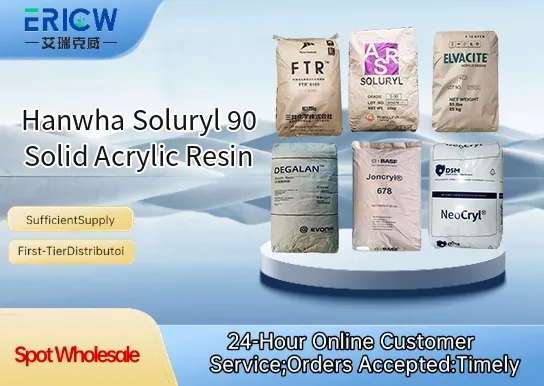
High molecular weight solid acrylic resin offering excellent hardness and film integrity.
Outstanding UV resistance and long-term color stability for outdoor durability.
Good solubility in common organic solvents including xylene, toluene, and ketones.
Low yellowing tendency and superior clarity in clearcoat and topcoat formulations.
Compatible with melamine formaldehyde crosslinkers for thermosetting coating systems.
Automotive OEM and refinish clearcoats.
Industrial maintenance coatings for metal substrates.
Architectural high-performance exterior coatings.
Plastic coatings requiring gloss retention and weatherability.
Can coatings for beverage and food containers.
| Chemical Type | Solid acrylic copolymer |
| Product Form | Free-flowing white to off-white granules |
| Appearance | Granular, homogeneous particles |
| Glass Transition Temperature (Tg) | ~90 °C (DSC, 10 °C/min) |
| Molecular Weight (Mw) | ~150,000–200,000 Da (GPC, PS standard) |
| Acid Number | 5–15 mg KOH/g |
| Volatile Content | ≤0.5 wt% (at 120 °C, 2 hrs) |
| Primary Applications | Thermosetting solventborne coatings |
Q1: What is the primary function of Hanwha Soluryl 90 in coating formulations?
A: Hanwha Soluryl 90 is a high-molecular-weight solid acrylic resin designed to enhance film formation, gloss, hardness, and chemical resistance in thermosetting coil and can coatings. It serves as a key binder component that improves crosslink density and overall durability without compromising application viscosity.
Q2: Is Soluryl 90 compatible with common crosslinkers used in industrial baking systems?
A: Yes, Soluryl 90 exhibits excellent compatibility with standard amino resins such as melamine-formaldehyde and urea-formaldehyde crosslinkers, as well as with epoxy and polyisocyanate systems. Its functional group profile supports efficient co-reactivity during thermal curing at typical industrial bake temperatures.
Q3: How does Soluryl 90 differ from liquid acrylic resins in terms of formulation handling and VOC considerations?
A: As a solid resin, Soluryl 90 enables higher solids content formulations with significantly reduced solvent demand compared to liquid acrylics. This contributes to lower VOC emissions during manufacturing and application, while offering improved storage stability and simplified handling in powder or high-solids liquid systems.
Q4: Can Soluryl 90 be used in food-contact compliant coatings?
A: Soluryl 90 is formulated for use in industrial protective coatings and may be incorporated into food-contact coating systems where regulatory compliance is achieved through full formulation evaluation. End-use compliance depends on the entire system—including crosslinkers, additives, and cure conditions—and must be verified by the coating manufacturer against applicable regional requirements.
Contact With Us:
E-mail: wangxingqiang@ericwchem.com
Have a Questions? Call Us:
Add:
Building A1, Jiete Industrial Park, Huangpu District, Guangzhou City, Guangdong Province, China