English
 Español
 tiếng việt
 русский
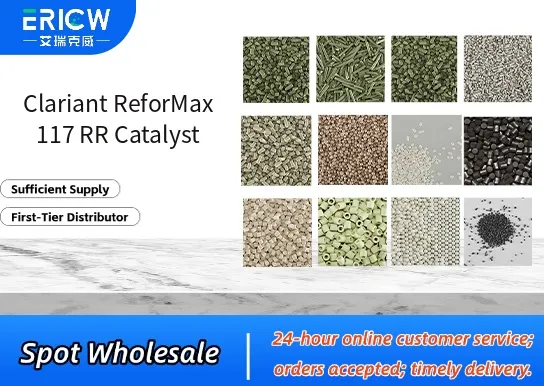
Highly selective for reforming reactions under low-pressure and low-severity conditions.
Enhanced resistance to sulfur poisoning and coke deposition during extended operation.
Optimized metal dispersion and thermal stability for consistent long-cycle performance.
Designed for regenerability in fixed-bed and semi-regenerative reformer units.
Reduces hydrogen consumption while maintaining high liquid yield and octane uplift.
Naphtha reforming in semi-regenerative catalytic reformers (SRR).
Production of high-octane reformate for gasoline blending.
Hydrogen generation in integrated refinery hydrogen networks.
Upgrading light naphtha fractions from crude distillation or hydrotreating units.
Refinery feedstock flexibility with tolerance to variable sulfur and nitrogen content.
| Chemical Type | Platinum–Rhenium on alumina support with proprietary promoter system |
| Product Form | Extrudates (cylindrical pellets) |
| Appearance | Gray to dark gray solid, free-flowing granules |
| Primary Applications | Catalytic reforming of naphtha feedstocks |
| Key Features | Sulfur-tolerant, regenerable, low-metal-sintering design |
| Benefits | Extended run length, improved C5+ liquid yield, stable octane number |
| Storage Requirement | Store in dry, well-ventilated area; protect from moisture and contaminants |
| Handling Precaution | Avoid inhalation of dust; use appropriate PPE during loading/unloading |
Q1: What is the primary function of ReforMax 117 RR in polymer processing?
A: ReforMax 117 RR is a reactive catalyst designed to promote controlled crosslinking and structural reinforcement in thermoplastic elastomer (TPE) and thermoplastic vulcanizate (TPV) formulations, enhancing melt strength, dimensional stability, and mechanical resilience during extrusion and injection molding.
Q2: Is ReforMax 117 RR compatible with common polyolefin-based TPVs?
A: Yes — it is specifically formulated for compatibility with EPDM/PP-based TPVs and other polyolefin-rich thermoplastic elastomer systems. It demonstrates good dispersion and reactivity without compromising phase morphology or long-term thermal stability under typical processing conditions.
Q3: How should ReforMax 117 RR be incorporated into a compound?
A: It is typically introduced during the masterbatch stage or final compounding step using standard twin-screw extrusion equipment. Pre-drying is not required, and it disperses effectively at standard melt temperatures and shear rates used for TPV production.
Q4: Does ReforMax 117 RR affect the recyclability or reprocessing behavior of TPVs?
A: When used within recommended dosage ranges, it supports consistent performance across multiple processing cycles. Its reactive nature minimizes volatile by-products, contributing to stable rheology and reduced odor during reprocessing — though optimal recyclability depends on overall formulation design and thermal history.
Contact With Us:
E-mail: wangxingqiang@ericwchem.com
Have a Questions? Call Us:
Add:
Building A1, Jiete Industrial Park, Huangpu District, Guangzhou City, Guangdong Province, China