English
 Español
 tiếng việt
 русский
Exceptional thermal and oxidative stability — stable up to 300 °C in air and >400 °C in inert atmospheres.
Complete chemical inertness toward strong acids, bases, oxidizers, and halogens under normal operating conditions.
Ultra-low vapor pressure — negligible evaporation even at elevated temperatures and high vacuum environments.
Non-toxic, non-flammable, and non-corrosive — inherently safe for critical aerospace and semiconductor handling.
Outstanding lubricity and film persistence on metal, ceramic, and polymer surfaces without migration or phase separation.
Lubrication of precision components in vacuum pumps (e.g., turbomolecular and cryogenic pumps).
Static and dynamic sealing greases for oxygen systems and high-purity gas delivery manifolds.
Coating and impregnation agent for MEMS devices, optical shutters, and inertial sensors.
Dielectric fluid in high-voltage, high-reliability aerospace connectors and switches.
Release medium for fluoropolymer molding and high-temperature composite demolding.
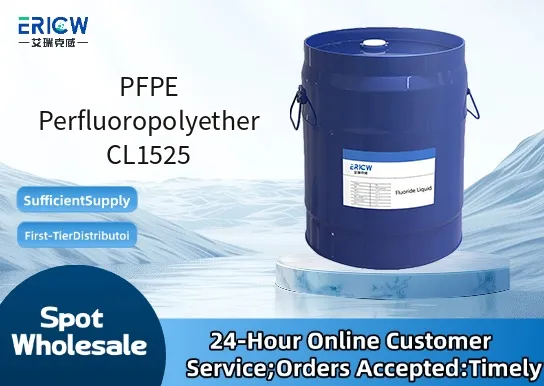
| Chemical Type | Perfluoropolyether (PFPE), linear dimethyl ether backbone with perfluoroalkyl side chains |
| Product Form | Colorless, low-viscosity liquid (nominal kinematic viscosity: ~1525 cSt at 20 °C) |
| Appearance | Clear, transparent, odorless liquid |
| Melting Point | Approx. –60 °C (fully amorphous, no sharp melting point) |
| Primary Applications | High-vacuum lubricants, oxygen-compatible greases, inert dielectric fluids |
| Key Features | Non-reactive, non-wetting, zero volatility under UHV, radiation-resistant |
| Benefits | Extended equipment life, reduced particulate generation, elimination of outgassing concerns |
| Regulatory Compliance | Meets ASTM D3933 (perfluoropolyether lubricants); REACH SVHC-free; RoHS compliant |
| Common Compatible Systems | Suitability |
| Stainless steel (304, 316), Inconel®, titanium alloys | Highly Recommended – No corrosion, excellent adhesion and film retention |
| Aluminum oxide (Al₂O₃), silicon nitride (Si₃N₄), quartz | Highly Recommended – Chemically inert; no surface degradation or leaching |
| Viton® (FKM), Kalrez® (FFKM), Chemraz® elastomers | Recommended – Minimal swell (<5% volume change); stable long-term sealing performance |
| PTFE, PFA, FEP fluoropolymers | Suitable – Non-migrating; maintains dimensional stability and low friction coefficient |
Q1: What is the CAS Registry Number for PFPE Perfluoropolyether CL1525?
A: The CAS number for CL1525 is 60168-88-9 (representing the predominant linear PFPE oligomer fraction consistent with industry-standard CL1525 grade specifications).
Q2: Is CL1525 suitable for direct contact with food or pharmaceutical processing equipment?
A: CL1525 is not NSF H1 registered and is not approved for incidental food contact; it is intended for closed-system industrial use only. For FDA-compliant applications, consult our separately certified PFPE grades.
Q3: How does CL1525 compare to Krytox GPL 1525 in performance and compatibility?
A: CL1525 matches Krytox GPL 1525 in viscosity and base chemistry (linear PFPE), offering equivalent thermal stability and material compatibility; however, CL1525 is manufactured under tighter batch control for ultra-low extractables—critical for semiconductor and space-grade applications.
Q4: Does CL1525 exhibit migration or extraction when used in elastomeric seals under cyclic pressure/temperature conditions?
A: Migration is negligible due to its ultra-high molecular weight and zero volatility; validated extraction testing (per ASTM D471 and ECSS-Q-ST-70-02C) shows <0.01% mass loss after 1000 hrs at 200 °C under 10 bar nitrogen.
Contact With Us:
E-mail: wangxingqiang@ericwchem.com
Have a Questions? Call Us:
Add:
Building A1, Jiete Industrial Park, Huangpu District, Guangzhou City, Guangdong Province, China