English
 Español
 tiếng việt
 русский
High thermal stability suitable for processing temperatures up to 800 °C.
Excellent lightfastness and weather resistance, maintaining color integrity under UV exposure.
Chemically inert with strong resistance to acids, alkalis, and solvents.
Non-toxic and compliant with major global regulatory frameworks including REACH and RoHS.
Consistent particle size distribution ensuring uniform dispersion and optimal opacity.
Ceramic glazes and underglaze decorations for tableware and architectural tiles.
High-performance inorganic coatings for industrial metal parts and exhaust systems.
Coloration of refractory materials including firebricks and furnace linings.
Pigmentation of glass enamels and low-melting-point specialty glasses.
Functional coloring agent in flame-retardant plastics requiring thermal stability.
| Chemical Type | Mixed-metal oxide (Fe–Cr–Al spinel-based) |
| Product Form | Free-flowing fine powder |
| Appearance | Brilliant red-brown granular powder |
| Primary Applications | Ceramics, refractories, high-temp coatings, glass enamels |
| Key Features | Thermal stability, chemical inertness, UV resistance |
| Benefits | No blooming, no migration, excellent batch-to-batch consistency |
| Density (g/cm³) | 4.2–4.5 |
| Moisture Content (wt%) | <0.5 |
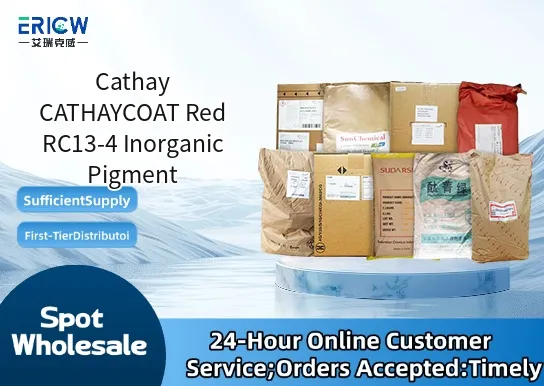
Q1: What is the primary chemical composition of Cathay CATHAYCOAT Red RC13-4?
A: Cathay CATHAYCOAT Red RC13-4 is an iron oxide-based inorganic pigment, formulated to deliver high thermal stability and consistent red hue performance in demanding industrial coating systems.
Q2: Is this pigment suitable for high-temperature curing applications?
A: Yes — RC13-4 exhibits excellent thermal stability and retains its color integrity during standard baking cycles used in coil coating, automotive OEM, and powder coating processes, typically up to 200°C.
Q3: How does RC13-4 compare to organic red pigments in terms of weather resistance?
A: As an inorganic pigment, RC13-4 offers significantly superior UV stability and long-term color retention compared to most organic reds, making it well-suited for exterior architectural and industrial maintenance coatings exposed to harsh environmental conditions.
Q4: What is the typical dosage range when incorporating RC13-4 into solventborne and waterborne industrial coatings?
A: Dosage depends on formulation requirements and desired opacity, but RC13-4 is generally effective at low concentrations — typically ranging from 0.1% to 2% by weight — due to its strong tinting strength and good dispersion characteristics.
Contact With Us:
E-mail: wangxingqiang@ericwchem.com
Have a Questions? Call Us:
Add:
Building A1, Jiete Industrial Park, Huangpu District, Guangzhou City, Guangdong Province, China