English
 Español
 tiếng việt
 русский
Excellent abrasion resistance for demanding mechanical service conditions.
High tensile strength and elongation at break, ensuring robust performance under dynamic stress.
Good low-temperature flexibility down to –30 °C, maintaining elasticity in cold environments.
Outstanding resistance to oils, greases, and many common industrial solvents.
Processable via standard thermoplastic techniques including extrusion, injection molding, and calendering.
Industrial hoses and pneumatic tubing requiring high pressure and flex fatigue resistance.
Roller covers and conveyor belts in material handling and printing equipment.
Seals, gaskets, and dynamic sealing components in hydraulic and pneumatic systems.
Protective sheathing for cables and wires exposed to mechanical wear and environmental stress.
Specialty footwear components such as midsoles and outsoles for high-performance athletic and work footwear.
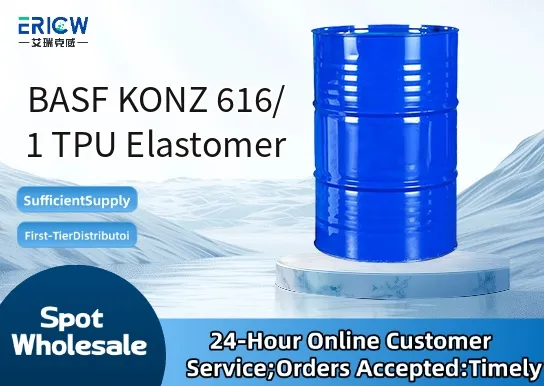
| Chemical Type | Thermoplastic Polyurethane (TPU), polyester-based |
| Product Form | Pellets |
| Appearance | Off-white to light yellow granules |
| Primary Applications | Extruded profiles, molded parts, coated fabrics, and flexible tubing |
| Key Features | High mechanical strength, oil resistance, low-temperature toughness |
| Processing Method | Extrusion, injection molding, blow molding |
| Density (g/cm³) | 1.18–1.22 |
| Melt Flow Index (230 °C / 2.16 kg, g/10 min) | 10–15 |
Q1: What is the primary function of BASF KONZ 616/1 in thermoplastic polyurethane (TPU) formulations?
A: KONZ 616/1 is a specialized processing aid designed to improve melt flow and reduce extrusion pressure during TPU compounding and profile extrusion. It enhances surface smoothness, reduces die build-up, and supports consistent pelletization—particularly beneficial for high-viscosity or filled TPU grades.
Q2: Is KONZ 616/1 compatible with all common TPU chemistries (e.g., polyester-, polyether-, and polycaprolactone-based)?
A: Yes, KONZ 616/1 demonstrates broad compatibility across major TPU base chemistries. It is formulated to remain stable under typical TPU processing temperatures (160–220 °C) without compromising mechanical properties or long-term hydrolytic stability—especially important for polyether- and polyester-type systems.
Q3: How should KONZ 616/1 be incorporated into TPU production—pre-blend or masterbatch?
A: It is typically introduced via dry blending with TPU resin prior to extrusion, or as a concentrated masterbatch for improved dispersion control. Pre-blending is preferred for standard applications, while masterbatches offer greater consistency in high-precision or low-dosage scenarios.
Q4: Does KONZ 616/1 affect the final product’s regulatory compliance for food-contact or medical applications?
A: KONZ 616/1 is not intended for direct use in regulated end-use applications unless validated within the full formulation and processing context. Customers must conduct their own regulatory assessments—including migration testing and toxicological review—as compatibility depends on the entire system, processing conditions, and target market requirements.
Contact With Us:
E-mail: wangxingqiang@ericwchem.com
Have a Questions? Call Us:
Add:
Building A1, Jiete Industrial Park, Huangpu District, Guangzhou City, Guangdong Province, China