English
 Español
 tiếng việt
 русский
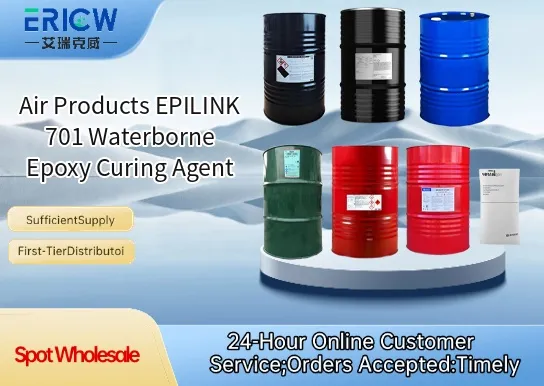
Waterborne, low-VOC formulation compliant with global environmental regulations including EPA and EU REACH.
Enables rapid ambient-cure epoxy systems with excellent early hardness development and chemical resistance.
Offers outstanding compatibility with a broad range of waterborne epoxy resins and co-solvent systems.
Delivers low odor and improved workplace safety versus traditional amine-based curing agents.
Provides good pot life stability in formulated coatings without premature gelation or viscosity drift.
Industrial maintenance coatings for steel structures and concrete substrates.
Waterborne epoxy primers and mid-coats in automotive OEM and aftermarket refinishing.
High-performance floor coatings for commercial, pharmaceutical, and food-processing facilities.
Anti-corrosive protective coatings for marine and offshore infrastructure.
Architectural epoxy systems requiring low-emission, indoor-safe application.
| Chemical Type | Modified polyamine, water-dispersible |
| Product Form | Liquid dispersion |
| Appearance | Opaque white to off-white liquid |
| pH (10% aqueous solution) | 9.5 – 10.5 |
| Solids Content (wt%) | 58 – 62% |
| Density (25°C, g/mL) | 1.04 – 1.08 |
| Viscosity (Brookfield RV, 25°C, mPa·s) | 1,200 – 2,500 |
| VOC Content (g/L) | < 100 |
Q1: What types of epoxy resins is EPILINK 701 compatible with?
A: EPILINK 701 is specifically formulated for use with waterborne epoxy dispersions and certain hydrophobically modified epoxy emulsions. It demonstrates good compatibility with standard bisphenol A-based and bisphenol F-based waterborne epoxy systems, enabling stable, low-VOC formulations with balanced pot life and cure performance.
Q2: How does EPILINK 701 contribute to film formation and final coating properties?
A: As a polyamine-based waterborne curing agent, EPILINK 701 promotes coalescence and crosslinking during ambient or mild-heat cure cycles. This supports the development of cohesive, chemically resistant films with improved hardness, adhesion to concrete and metal substrates, and resistance to water and mild chemicals—without requiring high-bake conditions.
Q3: Can EPILINK 701 be used in zero-VOC or ultra-low-VOC coatings?
A: Yes—EPILINK 701 is supplied as a water-based liquid with negligible VOC content, making it suitable for formulating coatings targeting zero-VOC or ultra-low-VOC compliance when paired with compatible waterborne epoxy resins and minimal co-solvent usage.
Q4: What is the typical mixing ratio range for EPILINK 701 relative to epoxy resin solids?
A: The stoichiometric ratio depends on the amine hydrogen equivalent weight (AHEW) of EPILINK 701 and the epoxy equivalent weight (EEW) of the selected resin. In practice, dosage is typically adjusted to achieve target performance, generally ranging from 0.1% to 2% by weight relative to total formulation, though optimal levels are determined experimentally based on desired pot life, cure speed, and film properties.
Q5: Does EPILINK 701 require special handling or storage conditions?
A: EPILINK 701 should be stored in tightly sealed containers at temperatures between 5°C and 30°C, protected from freezing and prolonged exposure to high humidity. It is not classified as hazardous for transport under UN regulations, but standard industrial hygiene practices—including gloves and eye protection—are recommended during handling to avoid skin or eye contact.
Contact With Us:
E-mail: wangxingqiang@ericwchem.com
Have a Questions? Call Us:
Add:
Building A1, Jiete Industrial Park, Huangpu District, Guangzhou City, Guangdong Province, China